 I just finished something I've been wanting to do for a long time. I made a list of all the books on my "special shelf" and put it on my philosophy site. If you'd like to see some of the books I like most, you can see the list HERE.

Saturday, December 3, 2005
Recommended Reading
I just finished something I've been wanting to do for a long time. I made a list of all the books on my "special shelf" and put it on my philosophy site. If you'd like to see some of the books I like most, you can see the list HERE.

Thursday, December 1, 2005
Seeing Order & God in the Woodwork
 Daniel Gilbert has written a very interesting article titled, "The Vagaries of Religious Experience" at www.edge.org. The article can be reached via this link.
In it, Gilbert explains why people tend to attribute things to a god and several other tangent notions. There are loads of fascinating references to interesting social experiments that make the article a real treat. I especially liked this bit...
"A Necker cube is an ambiguous object, which is to say that there is more than one way to see it, and our brains happily jump between these different views, trying one and then switching to another. But experiments show that if we are rewarded for seeing the cube one way rather than the other — rewarded with a jellybean, a dollar bill, or a friendly pat on the back — our brains begin to hold on to the rewarding view, and the cube stops changing. The lesson here is that things can be viewed in many ways, but human brains like the most rewarding view and thus they search for and hold on to that view whenever they can."
Thanks much to Paul at the International Stoic Forum for making me aware of this.
Terrel Pough & Being Good
 It has recently been reported that two men have been charged for murdering 18-year old Terrel Pough. Terrel had recently been featured in People Magazine for pulling his life together in order to provide for his daughter, Diamond. As People reported Recently...
"A former street-tough kid, Pough was raised by his maternal great-grandparents and never knew his own father. His life changed, however, when he learned at 15 that his then-girlfriend, Charmaine Houston, also 15, was pregnant. Although Pough and Houston drifted apart, Pough pledged to support their child... Pough was determined to find a good job in construction so he could provide greater opportunities for Diamond."
When I saw the arrests reported on television on the morning news, the reporters portrayed the irony of the event and the sense of futility was apparent in their tone. I thought that there must be many people out there struggling in harsh conditions who may be wondering, "what's the point of trying if this sort of thing can happen to people like Terrel?"
While it's true that bad neighborhoods and low-income areas have higher crime rates and are more dangerous, the fact is that any of us can die at any moment, for any number of reasons. There has always been a common frustration at these series of random events beyond our control. It was this which inspired Shakespeare's character Macbeth to bemoan that, unlike films and books, our life is instead "a tale told by an idiot, full of sound and fury, signifying nothing."
Many ancient Stoics, like folks today who live under dangerous hardships, lived in a world where life was often short, brutal, and cheap. They too saw life as a tragic hurricane of events larger than ourselves, which we are helpless to control.
But the Stoic response to this fact of life was to first recognize that it is this flow of events which allows us to exist in the first place. All things which we consider good and bad flow from that great flux of events. Other traditions and teachers have noticed this as well. Jesus of Nazareth pointed out that it rains on both the just and the unjust. The Buddhists refer to this tapestry of life as "Indra's Net". They would also note there is no way to win the "if only" game. Stoics would say that everything that is, is because of the Way of Nature, and there is no other way things can be, than how they are.
But secondly, and more importantly, the Stoics go beyond recognizing what we can't control and focus on what we can control. Stoicism teaches us that the only thing we can really control is our inner choices, and the only valuable thing we can ever call truly "good", is our choice to be virtuous. All else (family, friends, possessions, status, career) can be taken from us in a heartbeat.
If folks out there are thinking that all of Terrel's efforts to better himself to provide for his daughter were wasted or futile, then they should consider what effects his virtuous efforts really had, and will continue to have. Consider the support already provided to Diamond. Consider Terrel's inspiration to other young people like himself. Consider the inspiration Terrel's efforts and his fate has had on others to lend a hand to Diamond and her family. Consider what an inspiration Terrel will be to his daughter in years to come. Lastly, consider the fact that Terrel's life, while it lasted, was improved by the joy and pride inherent in doing the right thing and living a good life.
The Stoic Epictetus said that virtue was both necessary and sufficient for happiness. While a lot of events beyond our control can effect our lives, we control how we respond to those events, and that response goes back into that tapestry - usually continuing on to have effects larger than we imagined. Nothing can ever change the fact that we chose virtue when faced with the choice.
I never knew Terrel Pough, but I suspect that his years, obligations, and interests probably kept him from ever learning much about ancient philosophers. Be that as it may, the irony and pain of tragedy is eternal to all human beings and the wisdom found throughout the ages is therefore applicable today as well. Many of these thoughts, I'm certain, Terrel did understand, for as he himself once said, "If something ever happens to me, no one can ever tell her that her dad didn't take care of her."
----------------
I happened upon information for making donations on Bloggingbaby.com for those wishing to, and thought it would be a good idea to pass on the info...
Terrell Pough Memorial Fund
YouthBuild Charter School
1231 N. Borad Street
Philadelphia, PA 19122
Diamond Houston Fund
c/o Sovereign Bank
8319 Stenton Avenue
Philadelphia, PA 19150
Saturday, November 26, 2005
ONE YEAR OF BLOGGING!
Well, DT Strain Philosophy Blog has been going for a full year this month! It's passed by pretty quickly, but it's been a really fun experience. I hope to continue adding interesting posts as I explore more. I'm trying to go with at least one post per week, so hopefully readers can always bet on there being something that often. Sometimes though, I stick in more frequent posts, but that's the minimum.
Thanks much to all the readers of my blog for taking the time to check in once in a while and read! I hope you all have a great holiday.
Thanks much to all the readers of my blog for taking the time to check in once in a while and read! I hope you all have a great holiday.
Rand on Hold
Bah! Turns out my car was so packed full of stuff to transport in my move that I didn't have room to work a tape player (the Rand book was on tape and my car has a CD player). So, I wasn't able to listen to Atlas Shrugged on the trip as I had planned. I WILL be listening to it though, and will post as soon as possible.
In the mean time, I'm in the middle of holiday goings on at the moment, but will try to think up some juicy philosophic thoughts soon. :)
In the mean time, I'm in the middle of holiday goings on at the moment, but will try to think up some juicy philosophic thoughts soon. :)
Friday, November 11, 2005
Rand on the Road
 I'm going to be taking a long car trip (a few days) this Monday, and I'll be listening to Ayn Rand's "Atlas Shrugged" on tape; a fictional novel which I believe embodies her concepts on Objectivism. Here's how Publisher's Weekly describes the book...
With this acclaimed work and its immortal query, "Who is John Galt?", Ayn Rand found the perfect artistic form to express her vision of existence. Atlas Shrugged made Rand not only one of the most popular novelists of the century, but one of its most influential thinkers. Atlas Shrugged is the astounding story of a man who said that he would stop the motor of the world--and did. Tremendous in scope, breathtaking in its suspense, Atlas Shrugged stretches the boundaries further than any book you have ever read. It is a mystery, not about the murder of a man's body, but about the murder--and rebirth--of man's spirit. Atlas Shrugged is the "second most influential book for Americans today" after the Bible, according to a joint survey conducted by the Library of Congress and the Book of the Month Club.I'll write back next week with comments so stay clicked!
Friday, November 4, 2005
Dalai Lama Protests
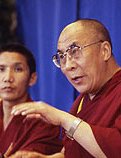 The Dalai Lama is speaking at Stanford University here in the San Francisco Bay Area today and, sadly, I can't go since (1) I have to work and (2) I found out too late to get a seat. However, it seems the event will be available as an audio download at Stanford university's site (here).
The Dalai Lama has been promoting communication between Buddhism and neurobiology for some time now. There have been some interesting brain scans and studies regarding meditation and its effects. The Dalai Lama regards this as an indication that Buddhism and science may both be helped by these sorts of interactions.
I have read some of his notions on this, and the Dalai Lama seems very respecting of the proper boundaries of science and religion. At the same time, there is no doubt that studying the brain scans of meditators can't hurt the neurosciences and may help shed some light on brain plasticity (the ability of the brain to reform its architecture). In addition, in the spirit of Einstein's ideal religion of the future, religion that is open to the wonders science reveals, and willing to integrate with those discoveries, can be a positive in my view. It seems that most neuroscientists have enjoyed the cooperation and have had no problem with it.
Strangely, some protesters were present at the Stanford event. I wondered what this might be about, as I had generally thought the Dalai Lama had a favorable reputation around these parts. Looking into it, I found that the protest was instigated by some neurobiologists.
I thought that seemed rather odd to be so opposed to someone even speaking in an open speaking event which was specifically billed as a means of increasing interaction between the public and neuroscience.
In their letter of protest, Yi Rao (a neuroscientist from the Northwestern University of Chicago) claimed to "fully support" promotion of interaction between the public and neuroscientists. The "public" should mean people from all walks of life, even (and perhaps especially) religious figures. But Apparently, Yi Rao's idea of "interaction" is the public sitting quietly while the neuroscientists tell them what's what.
He went on to criticize recent findings on brain activity in meditators to be untested and the research limited. This is probably true, but if this is the case, then most scientists would see that as the very reason why more data needs to be collected and more discussions on the topic explored. Instead, this scientist seemed strangely out of step with the normal reaction of most other scientists.
The letter also pointed out that the basis of the Dalai Lama's position was reincarnation, which is opposed to neuroscience (Dalai Lamas are believed by Tibetan Buddhists to be a reincarnation of the previous Dalai Lama). While science itself cannot rule out the supernatural, it certainly doesn't support it or assume it exists. So, there is some truth to this point. However, the Dalai Lama's subject matter in this event is not on reincarnation or anything else of a supernatural nature, but simply on meditation and its effects as can be measured by brain scans, and the possible fruits of cooperation between Buddhist meditators and neuroscientists. To exclude a person from the conversation simply because of their religious position and background is madness, and certainly out of step with most scientists. It would be like excluding a Christian pastor or priest that was an educated astronomer from lecturing on astronomy simply because his religious position was based on belief in a deity in human form.
In science (and logic in general) there is an admonition against taking arguments on authority. The inverse of this principle would also be true, which is that we don't outright reject what a person is saying because of who they are either. Each claim should be evaluated on its own merits with the evidence, and this goes for neuroscientists and religious figures alike.
If this were a scientific journal, then certainly any claims outside of rigid science should be excluded simply on the basis of category. But in a conference specifically designed to involve the public (and public figures) all voices should be heard. If there is genuinely something amiss in the Dalai Lama's claims then a true scientist will seek to counter them with superior argument and evidence - not censor them because of the person's position or faith.
Robert Desimone (Director of the McGovern Institute for Brain Research at the Massachusetts), agrees with this line of study on meditation and brain activity, but warns that scientific bodies should "distance" themselves from particular religious beliefs. I certainly agree with this, but this wise notion shouldn't be thought of as requiring that any and all things someone might have to say should be banned, simply because of their religious status.
Thankfully, Yi Rao and others who signed this letter seem to be in the minority and, as I suspected, out of step. Studying a variety of brain behaviors (including mediation) seems a perfectly legitimate scientific endeavor, and having religious people enthusiastically cooperative in these efforts is a bonus. But it's as if they were responding to some sort of pseudo science which had been shown to be bogus or was based on bad science.
Something didn't seem right about this so I did some more digging and, sure enough, both Yi Rao and the protest's organizer, neuroscientist Jianguo Gu (university of Florida) just so happen to be from China!
For those that don't know, the Dalai Lama and China have been at odds for a long time now because of a dispute over the sovereignty of Tibet. The Dalai Lama, who would have been Tibet's religious and cultural leader, fled when the Chinese government asserted its control over the region and has been traveling the world, writing books, and nurturing interfaith dialogue while hoping to also get the word out about Tibet's plight. China, needless to say, doesn't like this.
China has been nice enough to invite the Dalai Lama to return many times. But, given that the Chinese government took the Panchen Lama (2nd to the Dalai Lama) into "protective custody" ten years ago and has not been seen since, I can't say I blame the Dalai Lama from declining the invitation.
So, we're left wondering about this Yi Rao, Jianguo Gu, and a few others. Some online have been saying they are paid agents of the Chinese communist government, but far be it from me to claim to know such things. Perhaps they are just sadly warped by China's propaganda. Either way, although the Department of Homeland Security shouldn't bother itself with defending Dalai Lamas against lecture protests, these sorts of activities might be a secondary sign that looking into these folks backgrounds could be a good idea.
References:
San Francisco Independent Media Center:
http://sf.indymedia.org/news/2005/08/1718198.php
Berkeley information:
http://mcb.berkeley.edu/courses/mcb163/sfn.html
Original Nature article (should readers wish to subscribe to this fine magazine):
http://www.nature.com/news/2005/050725/full/436452b.html
Stanford event webcast:
http://dalailama.stanford.edu/video/
About the Dalai Lama:
http://en.wikipedia.org/wiki/Dalai_Lama
About the Dalai Lamas thoughts on science & neurobiology:
http://www.mindandlife.org/hhdl.science_section.html
Tuesday, November 1, 2005
Finding Happiness
A wonderful article on finding happiness was recently referred to me and others on the International Stoic Forum by a member named Paul. Nearly every paragraph has something juicy to pause and think over before proceeding...
http://www.timesonline.co.uk/printFriendly/0,,1-100-1793873-531,00.html
(note: if the link above has expired, I've replicated the article here so it isn't lost, but encourage you to read from the source if possible.)
I plan to eventually post my own commentary on this - thanks Paul!
http://www.timesonline.co.uk/printFriendly/0,,1-100-1793873-531,00.html
(note: if the link above has expired, I've replicated the article here so it isn't lost, but encourage you to read from the source if possible.)
I plan to eventually post my own commentary on this - thanks Paul!
Monday, October 31, 2005
Buddhist Mindfulness vs Taoist Flow
 I have recently been reading about Buddhism and the concept of mindfulness. The author mentions always being aware of all of the stimuli around you (breathing, footsteps, etc) and all of the little things we normally do on "autopilot".
This seems like a great practice and I can understand its appeal. Yet, previous to this I was reading about Taoism in Chuang-Tzu. There, he mentioned the centipede speaking with the walrus. The walrus asks the centipede how he handles so many legs. The centipede responds that he doesn't try to think about it, but lets it flow naturally. If he actually stopped to think about it, he'd trip.
This sort of automatic "flow" as it might be called, also seems to me to be an approach with good potential and application.
But how can I reconcile these two concepts, which seem directly at odds with one another? I know they both come from different traditions, but might there be some philosophy by which we can know when mindfulness is proper and when flow is proper? Both of these traditions seem to be encouraging them exclusively, but this doesn't seem like truth to me.
Sunday, October 30, 2005
Some Black Eyed Pea Wisdom
What's wrong with the world, mama
People livin' like they ain't got no mamas
I think the whole world addicted to the drama
Only attracted to things that'll bring you trauma
Overseas, yeah, we try to stop terrorism
But we still got terrorists here livin'
In the USA, the big CIA
The Bloods and The Crips and the KKK
But if you only have love for your own race
Then you only leave space to discriminate
And to discriminate only generates hate
And when you hate then you're bound to get irate, yeah
Madness is what you demonstrate
And that's exactly how anger works and operates
Man, you gotta have love just to set it straight
Take control of your mind and meditate
Let your soul gravitate to the love, y'all, y'all
--
It just ain't the same, always unchanged
New days are strange, is the world insane
If love and peace is so strong
Why are there pieces of love that don't belong
Nations droppin' bombs
Chemical gasses fillin' lungs of little ones
With ongoin' sufferin' as the youth die young
So ask yourself is the lovin' really gone
So I could ask myself really what is goin' wrong
In this world that we livin' in people keep on givin' in
Makin' wrong decisions, only visions of them dividends
Not respectin' each other, deny thy brother
A war is goin' on but the reason's undercover
The truth is kept secret, it's swept under the rug
If you never know truth then you never know love
Where's the love, y'all, come on (I don't know)
--
I feel the weight of the world on my shoulder
As I'm gettin' older, y'all, people gets colder
Most of us only care about money makin'
Selfishness got us followin' our wrong direction
Wrong information always shown by the media
Negative images is the main criteria
Infecting the young minds faster than bacteria
Kids wanna act like what they see in the cinema
Yo', whatever happened to the values of humanity
Whatever happened to the fairness in equality
Instead in spreading love we spreading animosity
Lack of understanding, leading lives away from unity
That's the reason why sometimes I'm feelin' under
That's the reason why sometimes I'm feelin' down
There's no wonder why sometimes I'm feelin' under
Gotta keep my faith alive till love is found
People killin', people dyin'
Children hurt and you hear them cryin'
Can you practice what you preach
And would you turn the other cheek
Father, Father, Father help us
Send some guidance from above
'Cause people got me, got me questionin'
Where is the love?
-- Black Eyed Peas, Elephunk
People livin' like they ain't got no mamas
I think the whole world addicted to the drama
Only attracted to things that'll bring you trauma
Overseas, yeah, we try to stop terrorism
But we still got terrorists here livin'
In the USA, the big CIA
The Bloods and The Crips and the KKK
But if you only have love for your own race
Then you only leave space to discriminate
And to discriminate only generates hate
And when you hate then you're bound to get irate, yeah
Madness is what you demonstrate
And that's exactly how anger works and operates
Man, you gotta have love just to set it straight
Take control of your mind and meditate
Let your soul gravitate to the love, y'all, y'all
--
It just ain't the same, always unchanged
New days are strange, is the world insane
If love and peace is so strong
Why are there pieces of love that don't belong
Nations droppin' bombs
Chemical gasses fillin' lungs of little ones
With ongoin' sufferin' as the youth die young
So ask yourself is the lovin' really gone
So I could ask myself really what is goin' wrong
In this world that we livin' in people keep on givin' in
Makin' wrong decisions, only visions of them dividends
Not respectin' each other, deny thy brother
A war is goin' on but the reason's undercover
The truth is kept secret, it's swept under the rug
If you never know truth then you never know love
Where's the love, y'all, come on (I don't know)
--
I feel the weight of the world on my shoulder
As I'm gettin' older, y'all, people gets colder
Most of us only care about money makin'
Selfishness got us followin' our wrong direction
Wrong information always shown by the media
Negative images is the main criteria
Infecting the young minds faster than bacteria
Kids wanna act like what they see in the cinema
Yo', whatever happened to the values of humanity
Whatever happened to the fairness in equality
Instead in spreading love we spreading animosity
Lack of understanding, leading lives away from unity
That's the reason why sometimes I'm feelin' under
That's the reason why sometimes I'm feelin' down
There's no wonder why sometimes I'm feelin' under
Gotta keep my faith alive till love is found
People killin', people dyin'
Children hurt and you hear them cryin'
Can you practice what you preach
And would you turn the other cheek
Father, Father, Father help us
Send some guidance from above
'Cause people got me, got me questionin'
Where is the love?
-- Black Eyed Peas, Elephunk
Subscribe to:
Posts (Atom)