Blog Site

Tuesday, August 22, 2006

Golden Rules from Many Cultures and Faiths

I posted something similar to this a while back, but not as extensive. I found this list posted from a user on the Comparative Religion Forums called DrFree, and thought it would be nice to share...

=================
The Golden Rule takes many forms in many faiths and cultures. Here is a sampling of various forms.


1. Therefore all things whatsoever ye would that men should do to you, do ye even so to them: for this is the law and the prophets.
Matthew 7:12

2. And as ye would that men should do to you, do ye also to them likewise.
Luke 6:31

3. Thou shalt not avenge, nor bear any grudge against the children of thy people, but thou shalt love thy neighbour as thyself: I am the LORD.
Leviticus 19:18

4. And the second is like, namely this, Thou shalt love thy neighbour as thyself. There is none other commandment greater than these.
Mark 12:31

5. And to love him with all the heart, and with all the understanding, and with all the soul, and with all the strength, and to love his neighbour as himself, is more than all whole burnt offerings and sacrifices.
Mark 12:33

6. And he answering said, Thou shalt love the Lord thy God with all thy heart, and with all thy soul, and with all thy strength, and with all thy mind; and thy neighbour as thyself.
Luke 10:27

7. Love worketh no ill to his neighbour: therefore love is the fulfilling of the law.
Romans 13:10

8. For all the law is fulfilled in one word, even in this; Thou shalt love thy neighbour as thyself.
Galatians 5:14

9. If ye fulfil the royal law according to the scripture, Thou shalt love thy neighbour as thyself, ye do well:
James 2:8

10. Do for one who may do for you, that you may cause him thus to do.
Ancient Egyptian, The Tale of the Eloquent Peasant The original dates to 1970 to 1640 BCE and may be the earliest version ever written.

11. One going to take a pointed stick to pinch a baby bird should first try it on himself to feel how it hurts.
African Traditional Religions, Yoruba Proverb (Nigeria)

12. Lay not on any soul a load that you would not wise to be laid upon you, and desire not for anyone the things you would not desire for yourself.
Baha’I, Bahá’u’lláh, Gleanings

13. And if thine eyes be turned towards justice, choose thou for thy neighbour that which thou choosest for thyself.
Baha’I, Bahá’u’lláh, Epistle to the Son of the Wolf, 30

14. Treat not others in ways that you yourself would find hurtful.
Buddhism, Udana-Varga 5,36

15. Comparing oneself to others in such terms as "Just as I am so are they, just as they are so am I," he should neither kill nor cause others to kill.
Buddhism, Sutta Nipata 705

16. Do not do to others what you would not like yourself. Then there will be no resentment against you, either in the family or in the state.
Confucianism, Analects 12:2

17. The essence of all religions is love, compassion, and tolerance. Kindness is my true religion. The clear proof of a person’s love of God is if that person genuinely shows love to fellow human beings.
Dalai Lama

18. Compassion is not religious business, it is human business, it is not luxury, it is essential for our own peace and mental stability, it is essential for human survival.
Dalai Lama, 1989 Nobel Peace Prize

19. If we really want happiness, we must widen the sphere of love.
Dalai Lama

20. Tsekung asked, "Is there one word that can serve as a principle of conduct for life?" Confucius replied, "It is the word shu--reciprocity: Do not do to others what you do not want them to do to you."
Confucianism, Analects 15.23

21. Try your best to treat others as you would wish to be treated yourself, and you will find that this is the shortest way to benevolence.
Confucianism, Mencius VII.A.4

22. The Sage...makes the self of the people his self.
Daoism, Tao Te Ching, Ch 49

23. One should not behave towards others in a way which is disagreeable to oneself. This is the essence of morality. All other activities are due to selfish desire.
Hinduism, Mahabharata, Anusasana Parva 113.8

24. This is the sum of duty; do naught onto others what you would not have them do unto you.
Hinduism, Mahabharata 5,1517

25. Humanists acknowledge human interdependence, the need for mutual respect and the kinship of all humanity.
Humanist Association of Canada

26. Don't do things you wouldn't want to have done to you.
British Humanist Society

27. Not one of you truly believes until you wish for others what you wish for yourself.
Islam, The Prophet Muhammad, 13th of the 40 Hadiths of Nawawi

28. One should treat all creatures in the world as one would like to be treated.
Jainism, Sutrakritanga

29. What is hateful to you, do not do to your fellowman. This is the entire Law; all the rest is commentary.
Judaism, Talmud, Shabbat 3id

30. What is hateful to you, do not do to your neighbour. This is the whole Torah; all the rest is commentary. Go and learn it.
Hillel, Judaism, Talmud, Shabbath 31a

31. We are as much alive as we keep the earth alive.
Native Spirituality, Chief Dan George

32. Act only according to that maxim by which you can at the same time will that it would become a universal law.
Philosophy, Immanuel Kant, Categorical Imperative

33. Act so as to use humanity, whether in your own person or in others, always as an end, and never merely as a means.
Philosophy, Immanuel Kant, Categorical Imperative

34. Do not do to others what would anger you if done to you by others.
Philosophy, Socrates

35. I am a stranger to no one; and no one is a stranger to me. Indeed, I am a friend to all.
Sikhism, Guru Granith Sahib, p. 1289

36. What you would avoid suffering yourself, seek not to impose on others.
Stoicism, Epictetus

37. Regard your neighbor’s gain as your gain, and your neighbor’s loss as your own loss.
Taoism, Tai Shang Kan Yin P’ien

38. We affirm and promote the inherent worth and dignity of every person.
Unitarian Universalist First Principle

39. We affirm and promote justice, equity and compassion in human relations.
Unitarian Universalist Second Principle

40. An' it harm none, do as ye will.
The Wiccan Rede

41. That nature only is good when it shall not do unto another whatever is not good for its own self.
Zoroastrianism, Dadisten-I-dinik, 94,5

42. Whatever is disagreeable to yourself do not do unto others.
Zoroastrianism, Shayast-na-Shayast 13.29

43. Before you criticize someone, walk a mile in his shoes.
American Proverb

44. Live and let live.
American Proverb

45. If you love something, set it free.
If it comes back, it will always be yours.
If it doesn't come back, it was never yours to begin with.
American Proverb

46. If you love it, let it grow.
American Proverb

Monday, August 21, 2006

P Funk 1

This man on the street conveys his position very well. We need more street philosophy like this...

Atheist Walking video on YouTube

Friday, August 18, 2006

U.S. and Turkey, Partners In Ignorance

In a recent news article (link), it was stated that the United States ranks near the bottom of the list, only second lowest to Turkey among 34 nations, when it comes to acceptance of Evolution. As the cornerstone of all modern biological sciences, the Theory of Evolution is as well-founded and supported by overwhelming evidence as any of our most solid theories. There really is no serious 'controversy' to speak of regarding evolution.

This is why I have a personal rule about debating Evolution: I simply will not debate the validity of Evolution with anyone who has not read at least one book on Evolution, written by what they would call an 'Evolutionist'. Predictably, I have yet to encounter such a person. I made this rule for myself after countless debates which resulted in the discovery that the other person invariably had ideas about Evolution that were not, in fact, what Evolution was about. Rather, it was a 'straw man' version of Evolution as described in one of many various 'pop-sci' books by disingenuous creationist authors who knew better. Secondly, to give credence to the position against Evolution would be like wasting time seriously debating someone over whether or not the Earth was flat or whether we 'really went to the Moon'. There are people in the world who stand for seeking truth through reason, and those who covertly stand for their own comfortable positions. Any sensible debater is wise to identify the latter quickly so as to ignore them.

Were it not for a bizarre mismatch between evolution and one particular fundamentalist religious viewpoint, no rational person would have a problem with Evolution. That viewpoint is the bibliolatry of literalism. Dr. Conrad Hyers, professor of comparative mythology and religious history, has written an article for Christian Century magazine I highly recommend called, "Biblical Literalism: Constricting the Cosmic Dance"(link). In one very interesting point, he says:

"The problem is, no doubt, further amplified by the obviousness and banality of most of the television programming on which the present generation has been weaned and reared. Not only is imagination a strain; even to imagine what a symbolic world is like is difficult. Poetry is turned into prose, truth into statistics, understanding into facts, education into note-taking, art into criticism, symbols into signs, faith into beliefs. That which cannot be listed, out-lined, dated, keypunched, reduced to a formula, fed into a computer, or sold through commercials cannot be thought or experienced."

He then goes on to point out:

"One of the ironies of biblical literalism is that it shares so largely in the reductionist and literalist spirit of the age. It is not nearly as conservative as it supposes. It is modernistic, and it sells its symbolic birthright for a mess of tangible pottage. Biblical materials and affirmations -- in this case the symbolism of Creator and creation – are treated as though of the same order and the same literary genre as scientific and historical writing. “I believe in God the Father Almighty” becomes a chronological issue, and “Maker of heaven and earth” a technological problem."

Evolution shows us something magnificent, intricate, and beautiful about the universe we live in. I pity those who can't appreciate that wonder because they've been mislead by ideas that were authored by the ignorant and fearful. What is really sad about this whole thing is how unnecessary it is. Many religious people, perhaps most, have no problem with Evolution, and even see it as a part of God's creation.

I would suggest that we not ridicule those who have been mislead by claims there is some sort of conflict between religion and Evolution. At the same time, we shouldn't give undue credence to debating Evolution with someone who knows of it only through the eyes of biased detractors. Instead, we should act kindly toward these folks. We shouldn't be imposing or offensive, and instead gently guide them to more informed reading, answering any honest questions they may have.

For those who may be reading this who think Evolution is 'just a theory' or don't accept it on religious grounds, I would hope you may read the article by Dr. Hyers linked to above, and then perhaps explore the website below. If anyone else knows of good resources for such folks, please post them in the comments.

Information on Evolution:
TalkOrigins.org

Friday, August 11, 2006

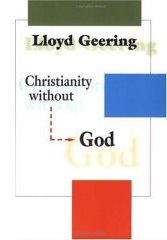
Notes on "Christianity Without God"

I’ve recently completed reading the book Christianity Without God, by Lloyd Geering. Geering is Emeritus Professor of Religious Studies at Victoria University, Wellington, New Zealand. I gave a review of this book followed by discussion at for my local Humanist group a few days ago.

The very notion of non-theistic Christianity may seem ludicrous to many modern conservative Christians. It probably sounds like “democracy without voting” or “football without a ball” or perhaps “chocolate milk without milk”. This is because of an interesting fact about most conservative Christians: they don’t know much about Christianity or their own Bible.

Geering’s book is a light and easy read, and is structured like one long argument; a series of premises culminating in its conclusion. For purposes of scholarship and review, I’ll point out some of the gems from its ten chapters (partially quoted and partially paraphrased), which are as follows...


• While modern science has changed our understanding of the world, we once understood it through the eyes of the Bible. The Bible was elevated in its authority as a means for the Protestants to defend their actions against the authority of the Catholic church. In their ‘Reformed Confessions on Faith’ trust in the Bible became the first article, and God is mentioned in the second. This had the little-appreciated effect of demoting God and made the Bible into an idol (see my post on Bibliolatry).

• The act of discarding outworn beliefs may not be a ‘lack of faith’ but rather the opposite. It may open the door for genuine faith to operate again. “The assertion that one needs to believe in a particular creed or set of doctrines in order to have faith is an invitation, not to faith, but to credulity.” Doubt is the enemy of false beliefs - as such doubt is not the enemy of faith but its ally.

• From Zoroastrianism and Hellenism to Judaism, Islam, and Christianity, these are all streams flowing into various branches, transforming as they go. The modern secular world, with all of its faults and problems, represents a new but legitimate stage in the Judeo-Christian cultural stream. Just as Gentile Christianity, Medieval Christendom, and Protestantism were new phases in their eras – thus, the global secular world is not the end of the Christian stream, but its next phase.

• Don Cupitt, in his 1981 book, Taking Leave of God, said that, whereas the realist traditional view of God imagines him as an objective being, the non-realist treats all God-talk as symbolic language which, though originating in ancient mythology, may still be useful in order to refer to the highest ideals, values, and aspirations to which we feel obliged to give our allegiance.

• Christians are not actually theists, but rather trinitarians. Most Christians who try to defend theism unconsciously focus on the Father Creator third and identify him alone as God.

• Tertullian, who lived from 160-200 CE, wrote the earliest reference to the trinity, although the seeds were present before then. But it wasn’t until a full two centuries after him that the trinity concept received full authorization.

• Both James and Peter viewed Jesus with Jewish eyes – as Messiah but as a full human being just as themselves. They were rejected by Jews for declaring a Messiah and given a “cold shoulder” by the Gentile Christians for not accepting Jesus as divine. We hear nothing more of them after the 5th Century.

• To fill the vacuum left by the failure of a quick second coming, early Christians engaged in a mental construction of an unseen supernatural world over the 2nd and 3rd Centuries. While the Jewish prophesy referred to a literal and physical ‘Heaven & Earth’ which had failed to arrive, it was replaced in this new supernatural scheme as a non-physical ‘Heaven & Hell’.

• One Baptist minister who Geering spoke to said, “There are three books of the Old Testament for which I have no respect at all... The book of Esther never mentions “God” at all, the Song of Songs is a collection of erotic love songs, and Ecclesiastes was written by an agnostic.”

• The humanist tradition of Hebrew Wisdom did not look to Yahweh to deliver people by miraculous interventions in either nature or human history. It taught people to pursue the way of Wisdom and it relegated God to the role of an impersonal creative force which had shaped the world to be as it was.

• Christianity’s focus shifted from its original roots – from the message to the messenger.

• Jesus stood in the Wisdom tradition more than anything else. It has led Robert Funk to say, not only that “Jesus is one of the great sages in history” but that “Jesus is also a secular sage. His parables and aphorisms all but obliterate the boundaries separating the sacred from the secular.”

• However, the Wisdom stream became completely overshadowed by the Pauline Gospel of the savior Christ, crucified, risen, and glorified.

• Protestants sought freedom from the bondage of the Catholic Church. But that freedom soon developed into another form of bondage – enslavement to the written word of the Bible. This has reached its most rigid form in modern fundamentalism.

• What is important to understand is simply this: the modern secular, humanist, post-Christian world not only flowed out of traditional Christianity but manifests the continuing development of elements intrinsic to the Judeo-Christian tradition. For this reason the modern secular and humanist world can legitimately be called ‘Christianity without God’.

• In ‘Christianity without God’ there is no place for the traditional figure of Christ as the divine Savior. Yet there is certainly a place for Jesus the teacher.

As we discussed at the gathering, Christianity (indeed many religions) has the interesting habit of changing to adapt to its time and circumstances, and often these changes would be downright heretical to previous generations of their same faith – even their same denomination. What’s most interesting is not so much the evolution of the faith, but the practice of covering their tracks. Each generation is taught “this is the way it has always been” and imagine that if they were to meet Jesus, all parties would all be on the same page. Even in cases where the evolution of their beliefs is acknowledged, the rationalization is often that previous incarnations were a distortion and the current one is in line with the true beliefs according to Jesus. But as Geering points out, nothing of the sort is true. To the contrary, the beliefs of modern mainstream conservative Christianity would be completely alien to the historical Jesus.

As a Humanist, this book left me wondering, ‘Why all the bath water?’ but this book wasn’t designed to approach pure Humanists in an attempt to convince them to become Christians. Rather, it seems to be aimed at Christians in order to show that that they need not give up their Christian cultural heritage in order to follow a more sensible, realistic, and convincing system of thought. More importantly, that system of thought is naturally derived from Christian history and recalls its roots in all the ways that matter most.

In his review of this book in The Humanist, Joseph S. Silverman, M.D. said:

“Humanistic Judaism. Humanistic Christianity. It may be quite a wait until Humanistic Islam. We should all live so long.”

America, Israel, and the Apocalypse

I usually try to stay centered on philosophy, rather than veering too much into mythology or folklore, but the effect of such on modern events cannot be denied.

Jason Boyett has recently written a nice article called "Apocalypse Soon" at Salon.com which takes a look at the United States' support of Israel, and the beliefs of Christianists concerning the Jewish people and the 'last days'. The article can be read HERE (you should make sure your pop-up blockers are on). Special thanks to Jim Kinierien for bringing it to my attention.

One of my favorite parts reads:

"There are no prophecies that have to be fulfilled before the Rapture," [Terry] James [rapture author] says. "It's imminent." In fact, the Rapture has been imminent for 2,000 years.
Which brings to mind a wonderful episode of Frontline on PBS I saw shortly before 2000 called "Apocalypse!". It was a remarkable special going into detail on the history of the concept. I thought it such a good documentary that I ordered the videotape. If you'd like to order it, you can do so by clicking HERE. Also, there is a nice website that is connected with the program HERE.

About the 'chosen people' concept, one thing I always thought peculiar: In whose holy books is it written that the Jewish people were God's chosen? Big surprise, Jewish people's. Why is it that the Aztecs, Egyptians, Greeks, or Indians didn't write that the Jews were God's chosen? Interesting and convenient.

Monday, July 31, 2006

Interesting Image

I saw this image of a religious soldier associated with an AP article yesterday. The juxtaposition in this picture pretty much says it all (for all religions, sides, nations). Hopefully, images like this won't turn out to be iconic for the 21st Century.

Friday, July 28, 2006

Exchange with John Horgan on Naturalistic Buddhism

John Horgan is a freelance science writer, now writing for The Center for Science Writings. His blog site, is called the Scientific Curmudgeon. I came across an article of his at Slate.com called "Buddhist Retreat: Why I Gave Up On Finding My Religion". I then had some interesting email exchanges with him on the subject of naturalistic Buddhism. I shared my article on Naturalistic interpretations of Karma and Rebirth, and he shared two of his articles. In the end, he said I made some very good points and that he was trying to keep an open mind. If you'd like to read our exchange, it can be found HERE.

Monday, July 24, 2006

Stoicism on Philosophy Talk

There is a Philosophy radio show called "Philosophy Talk". I often listen to podcasts of their programs after they've aired, available on their website. Not long ago, I emailed them and suggested they cover Stoicism and they said that it would be a good idea.

Just today, I checked back on their site and, by coincidence, they are doing a show on Stoicism tomorrow (July 25).

Instead of hearing a recording, I think I'm going to see if there is any possibility of hearing it on the radio live in my area (not sure). In any case, I just wanted to let everyone know. Philosophy Talk's website is at...

http://www.philosophytalk.org/upcoming.htm

Update: Philosophy Talk is aired live on KALW 91.7 Tuesdays at noon (Pacific time). If you don't get this station you can hear a live audiostream of the program here:
http://www.sfusd.k12.ca.us/programs/kalw/listen.html

Thursday, July 20, 2006

The Puzzle of Our Time

I don’t often touch on politics on this blog; at least not current hot-button political issues. The reasons are several: (1) I want this site to be about philosophy and getting overly specific about politics has a very dominating and distracting effect, (2) if dealing with politics, I prefer to stay in the abstract philosophical realm, because that’s where all the root answers tend to be anyway, and (3) my hope is to focus more on things that unite rather than divide.

However, this latest struggle between Israel and Hezbollah has got me vexed. In fact, much of the developments in the war on terror over the past few years have vexed me. Of course, I have my own opinions about various things and they can be quite strong, but I want to go beyond that – I want to go deeper. It’s too easy to merely vent my perspective and be yet one more voice yelling about what ‘should be’.

This whole business of terrorism, the third world, religious extremism, international business interests, modern warfare, and their intersection are really the great puzzle of our time. But instead of anyone trying to figure anything out, it seems that all we have are various religious fundamentalists (on all sides), various nationalists (on all sides), various haters of particular political officials, and other people with agendas simply trying to further them. If there are any people with serious deep questions and thoughts about this puzzle of our time out there, they are being ignored as eggheads or muffled by all the sensationalism to be found elsewhere. Can we please have some sincere efforts to reach pragmatic and realistic solutions without being so biased, hateful, blame-seeking, or focused on complaining about the present or past?

Everybody knows what should be done, and what the other guys should be doing. They know what should have happened in past elections, negotiations, and military actions. They know what we should be doing internationally, and they know what we should do in the future. But does anyone have any ideas about what can be done? In other words, what can be done given our current situation and the current dispositions of all parties involved?

There are obviously tough challenges facing the world, and they’re not going to be solved by simply declaring cease-fires and trying to get people not to attack one another. The underlying causes of these things are too complex and the dangers too intense. If one side is unwilling to cease, then those threats will demand that some fighting will have to happen. But the problems also aren’t going to be solved by obliterating everything without foreseeable end.

What’s even more complex is that it takes more than even a complete analysis of all the subtle underlying causes for things. Because, even if we had that, it would be another matter entirely getting all of the various power-holders, organizations, and institutions to actually pay attention, care, and change.

It's more than a little disturbing that all of our religious faiths and even our philosophic insights, including my own, seem incapable of easily piercing this dilemma, even if they may be very effective on an individual scale. This puzzle of our time is going to require something radical; something drastic. A new movement or perhaps a joint multi-cultural revolution of sorts happening in several opposing camps at once. Unfortunately, such things don’t usually arise unless extreme pain and suffering has pushed the pendulum far enough.

But one thing is sure, the puzzle is more complicated than a giant ball of tangled twine, and we have several people pulling on the same threads in different directions, trying to unravel it at the same time. If we can’t get some sort of broad and deep solutions going, then I suppose pain and suffering for a lot more people, on a lot greater scale, will be what’s in store. If that’s the case, then I’ll simply have to remember my Stoic readings and remind myself that I can’t control the choices or actions of others – only myself.

Thursday, July 13, 2006

Prescriptive Songs

There is an interesting thing I’ve noticed recently about certain types of songs, which I’ll call ‘prescriptive songs’. These are songs which the character singing is giving advice or instruction to another. Three examples I thought of are: “I Hope You Dance” by Lee Ann Womack, “Forever Young” as sung by Rod Stewart, and “Just the Two of Us” as rapped by Will Smith.

In all three of these songs, the singer is giving advice for living and hopes for a good life apparently to a young child, usually their own. I analyzed the lyrics of each of these songs line by line, and identified three different types of statements:

(1) Ethical Prescriptives: These are instructions on how a child should behave, and are of an ethical nature. They deal with matters of morality, virtue, ethics, honor, integrity, kindness, and so on.

(2) Non-Ethical Prescriptives: These are instructions on how the child should act, behave, or carry out life, but they are not ethical. This means they may simply be meant as good advice, or strategic manners of living.

(3) Hopes for good fortune: These are simply lines which express hopes for good fortune for the child, usually in the form of access to opportunity, health, good relationships, or material wellbeing.

There were a number of other lines which were either continuations of the same concept, repeats, or irrelevant to any of these, which I ignored. Here is how the three songs broke down...

I Hope You Dance
Ethical prescriptives: 19%
Non-ethical prescriptives: 62%
Good fortune: 19%

Forever Young
Ethical prescriptives: 67%
Non-ethical prescriptives: 0%
Good fortune: 33%

Just the Two of Us
Ethical prescriptives: 67%
Non-ethical prescriptives: 11%
Good fortune: 22%

There are a few interesting things I found as I looked over these songs and compared them. First, I can’t help but think that the various percentages reflect the time, subculture, and artists personality and beliefs from which they sprang. Surely, none of these artists analyzed the percentage of each type of statement, but it seems likely that they would tend to dwell on proportionate areas according to their inclinations.

But most importantly, I noticed something philosophically significant about what all of these songs were doing. Here we have three examples of a litany of ethical prescriptives. To name a very few, these include things like:

Give the heavens above more than just a passing glance.
Do unto others as you’d have done to you.
Always tell the truth.

Yet, the tone of all of these songs is not one of admonition, warning, condemnation, or seeking to impose control over the child. In all of these examples, the tone is one of seeking to deliver to the child that which will ensure prosperity and happiness in life. Most people don’t seem to understand that ethical prescriptives are not restrictions, but rather go hand in hand with happiness. Considering that most people don’t know this, the fact that these ethically prescriptive-laden songs are delivered in the tone of help rather than imposition of rules is really quite profound. It may be fitting to draw attention to these sorts of songs, and their loving, caring motivation, when attempting to explain to young people what ethics are all about.