This week something very interesting happened to the United States. It moved, yet another step away from the United States even people my age grew up in – not the dictatorship that reactionaries might characterize things, but not quite the free democracy that the founding fathers envisioned either.
Last Tuesday, the
Military Commissions Act of 2006 was signed into law[1]. It is, yet again, one of those tools we’ve created to fight against the bad guys. What has this got to do with philosophy?
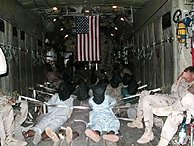
Philosophy includes religious ideas, political principles, the concept of rights, and more. What is terrorism? When should it, if ever, be used? What do we do in response to it? How many lives are worth a change of government? What is torture? Should we torture? How many rights are worth our security? What practical options are there to war? How should we treat our enemies? All of these are philosophic questions and, far from sitting on dusty bookshelves, they are profoundly impacting our world and our very lives today. The ‘War on Terror’ itself is an ideological battle, strewn throughout with conflicting philosophic ideas and ideals. This philosophical struggle is not merely between the terrorists and the rest of the world, but it is also between different nations, and different groups and individuals within nations.
So, when the
Military Commissions Act of 2006 (MCA2006) was signed last Wednesday, it was based on a philosophic vision of how things ‘ought to be’. Much more, it solidified that philosophic vision into policy. Some of the key points of interest in this act are as follows:
1) It defines who is an ‘unlawful enemy combatant’ and solidifies broad power of the President to, for all practical purposes, unilaterally declare someone as such (as long as he can find three officers to appoint to a tribunal who will go along with it).
2) An ‘alien unlawful enemy combatant’ is defined as being an ‘unlawful enemy combatant’ who is not a citizen of the U.S.
Once the President (in effect) has decided you are an ‘alien unlawful enemy combatant’...
3) You may not invoke Geneva Convention protections in this or any other American court.
4) Effectively, the right of Habeas Corpus is nullified.
5) The President has the sole authority to determine whether or not all of this is in compliance with the Geneva Conventions.
6) Hearsay evidence may be used against you.
7) Evidence may be used against you that was obtained without a search warrant.
8) Evidence, if the government decides it is classified, may be used against you which you are not allowed to see.
9) Evidence may be used against you when the degree of coercion (including torture) used against you to obtain it is disputed. In other words, if the people who tortured you say they didn’t, that’s enough to admit the evidence.
10) Only a 2/3 vote is needed to declare judgment on you.
11) Narrows the effective definition of torture to ‘severe’ physical or mental pain or suffering.
All of the above are contrary to the many protections the U.S.
Bill of Rights affords to its citizens. These same protections can be found in international common law and the
U.N. Universal Declaration of Human Rights. They are designed to make trials more fair, impartial, and accurate than they would be otherwise. Without the sort of protections nullified by the above, proceedings tend to evolve into ‘kangaroo courts’, where a person who the prosecutors want to find guilty, will be found guilty regardless.
Amnesty International says of this act that it allows[2]:
- Secret detention
- Enforced disappearance
- Torture and other cruel, inhuman or degrading treatment
- Outrages upon personal dignity, including humiliating treatment
- Denial and restriction of habeas corpus
- Indefinite detention without charge or trial
- Prolonged incommunicado detention
- Arbitrary detention
- Unfair trial procedures
Some might take comfort in knowing that this sort of process has been used before, or that it can only apply to
alien unlawful enemy combatants and not citizens. Indeed, there is a great debate going around on whether or not these provisions of the MCA2006 could in fact be applied to a U.S. citizen.
In the draft legislation
Domestic Enhancement Security Act of 2003 (also referred to as the Patriot Act II), the Department of Justice suggested (in Section 501) that U.S. citizenship be stripped of anyone the President decided to call a ‘terrorist’[3]. If something like that act were to go into effect, then a U.S. citizen could quickly go from being an ‘unlawful enemy combatant’ to being an ‘alien unlawful enemy combatant’ where all of the MCA2006 would apply. All of this categorization would happen based on nothing substantially more than the President’s individual desire.
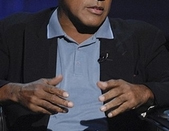
Constitutional law professor Jonathan Turley (who testified in favor of the Clinton impeachment, by the way) said of the MCA2006,
“The framers created a system where we did not have to rely on the good graces or good mood of the President... people have no idea how significant his is.”[
video here] [4]
Constitutional law attorney Alison Nathan wrote,
“...the U.S. Constitution establishes as a fundamental structural premise that there will be three independent branches of government that serve as checks and balances upon each other. Removing entirely the independent judiciary from any role in checking the conduct of the Executive and Congress is a substantial alteration to that structural premise.”[5]
There are those who simply hate the Republicans or the President and make wild statements for this or other political reasons. They will invoke all sorts of conspiracy theories about 9/11, make melodramatic statements about dictatorships, or have ridiculously wide-sweeping definitions of terrorism such that it includes their political opponents. This is not unlike wild claims about liberal agendas or of President Clinton having murdered troublesome people. Philosophers who concern themselves with Truth and genuine wisdom must be above this sort of political demagoguery. What is more difficult is parsing our fact from fiction; spin from genuine reason. Those who make overstatements and distort information for some perceived greater good, are as much of a problem as those they criticize, for they make it difficult for reasonable people to understand what is really happening and to then do something about it. Further, they create a sense of helplessness by suggesting that things are far more hopeless and ‘rigged’ than they really are – thus minimizing the public’s willingness to act.
Still, all demagoguery aside, reading several sources, one can’t help but get the feeling that there is something happening in this nation - something disturbing for which we are all to blame, regardless of party or position. Even on the highly and inflammatory conservative radio talk show of Michael Savage, where pleas to bomb the entire Sunni triangle are the norm, a loyal listener and Christian conservative asked,
“I wonder if some of these laws we’re passing might come back to hurt Christians later on?”[6]
Professor Benjamin Davis of the University of Toledo College of Law says,
“Something deep in the American soul was stirred by the 9/11 events. Something that reminds me personally of what one sees in the eyes of lynch mobs in the old pictures.”[7]
This mentality is playing out in our courts and in our laws. If someone were to declare an outright coup and attempt a dictatorship, that would probably be preferable. At least then it would be obvious what is being done and by whom, and what must be done to stop it. But it seems our loss of liberty is not to come with the marching of soldiers down our street. More likely, it is slowly degraded away law by law. For people about my age and older, it is easy to forget that there are people who can vote now with no active memory of the Soviet Union or even a world before the first Gulf War. Each generation that grows up will think it’s normal for a President to be able to sweep people off the street by declaring them ‘terrorists’. And, in that environment, how much easier will it be to take the small next step? An average human life lasts a fewer number of decades than the number of fingers we have to count them, and the average human adult voting life is even shorter. It thus becomes quite easy to change what is palatable to U.S. citizens little by little until those of perhaps two or three generations prior would hardly recognize the country.
The really concerning thing about efforts such as the MCA2006 or the draft Patriot Act II, is their subtle legalistic thinking and their interplay with one another. Notice how key phrases from other documents are used in clever ways, like a shell game.
This is why we hear so much talk about ‘the rule of law’. Notice that we hear relatively little talk from those in office about foundational principles of the variety that the founders spoke of. The reason the ‘rule of law’ is more prevalent in their rhetoric these days is because our focus is being directed to the legalistic word game. It is important that we have clear laws that are followed and respected,
but without a sound philosophic basis of principle, the ‘rule of law’ alone becomes nothing more than the ‘rule of lawyers’. This is a losing game for the people, where literally any freedom or right can be taken away, nearly any atrocity made proper, by the mere careful arrangement of words and phrases in document after document.
All of this debate over whether or not the MCA2006 can be applied to U.S. citizens is an example of being suckered into that game. Instead of being so concerned with the specifics of legal minutia, which none of us non-attorneys have much chance at doing well to begin with, we should be focusing our attention elsewhere.
The fact is, that when we attempt to revoke or suspend basic human rights for one class of people, this inevitably comes back to infringe on the rights of more people than we intended. If one person’s rights can be taken away, we are all in danger. When the founding fathers set forth the Constitution and the Bill of Rights, they weren’t playing a word game designed to preserve privileges for them and theirs. The Declaration of Independence was not a legal argument – it was a philosophic argument of principle. They weren’t attempting to provide legal procedures to be followed for those who had the proper label applied to them. The rights they proclaimed were proclaimed on a universal basis, endowed throughout mankind. Surely, it took long while to fully acknowledge who was included within mankind, but the basics of liberty were certainly never envisioned as pertaining only to U.S. citizens. Their basis was a broad ethical and philosophic one, not a narrow legalistic one. These documents were surely penned by men who thought that all people, regardless of citizenship, are
human beings first.
Alison Nathan pointed out something along these lines in quoting Alexander Hamilton[5]:
“To bereave a man of life …without accusation or trial, would be so gross and notorious an act of despotism, as must at once convey the alarm of tyranny throughout the whole nation; but confinement of the person by secretly hurrying him to jail, where his sufferings are unknown or forgotten, is a less public, a less striking, and therefore a more dangerous engine of arbitrary government.” -- Federalist No. 84
Davis noted of the MCA2006,
“For this special process, this group of human beings is segregated from the rest of mankind. They are segregated and by that segregation they are declared a different type of human being.” [7] He goes on to show that the procedures of MCA2006 are decoupled completely from all other legal processes, isolating them in their own realm.
That is what we must ask ourselves now: what kind of people are we? Do we really wish to create a ‘special class of human being’ that is not worthy of the basic protections to a free and fair trial when accused? Do we wish to create a special label our ruler can apply to any human being which removes what is essentially their personhood? We harm ourselves when we do this, and it is my hope that more people will come to see that, soon.
Update, January 9, 2012 (5 years later):
It has now been 5 years since the article above was written. Unfortunately, we have not, as a nation, asked ourselves what kind of people do we wish to be. Efforts like those described above have continued relentlessly. It's true that progress was made when Obama came into office and ordered the use of torture (including waterboarding) banned, ordered our interrogation standards to be compliant with the military code of conduct (and with the Geneva Conventions), and ordered a closing of the 'black site' secret prisons. However, Congress has fought back hard against his efforts to close the Guantanamo Bay prison. They eventually attached a legal restriction against trying those prisoners in the U.S. to a critical defense bill the President had little option but to sign, which makes processing the prisoners there properly impossible. Obama has also not reversed policies on warrantless wire-tapping, as many hoped he would.
More to the issues of this article, today we face a similar tandem interplay of laws designed to accomplish the same one-two punch. The National Defense Authorization Act of 2011 has now given the President the power to indefinitely detain anyone he suspects of terror related activities indefinitely and without access to an attorney or a trial. This action is required for non-U.S. citizens. But a revision before the law passed excluded citizens from this requirement, though did not remove the President's power to do so with citizens if he chooses. This has confused many people into thinking that citizens were excluded from indefinite detention in the NDAA, which is not the case. So this NDAA has done even more harm than the MCA 2006 did.
Nevertheless, the issue may be moot, in that HR 3166 and S. 1698 (also known as the Enemy Expatriation Act) is being considered in the Congress. While the Domestic Enhancement Security Act of 2003 mentioned in the article above never came into fruition, they are trying once again to make it legal for the government to strip you of your citizenship with these latest bills. It seems inevitable the U.S. will have all of these powers eventually, and the Bill of Rights will continue to be slowly revoked.
NOTES:
I highly recommend reading and watching all of the following references, and any others that can be found. More importantly, I highly recommend participation in all elections by at least voting:
[1]
Wikipedia article: Military Commissions Act of 2006
[2]
Amnesty International on the MCA2006
[3]
Wikipedia article: Domestice Security Enhancement Act of 2003
[4]
VIDEO: Jonathan Turley on CNBC
[5]
History Starts Today: The Perils of Habeas-Stripping
[6] This was something I heard while listening to the Michael Savage show about a year or so ago, before I quit listening to that sort of media. I have no specific reference information on it.
[7]
'All the Laws But One': Parsing the Military Commissions Bill
See also, a PDF of the full text of the Military Commissions Act of 2006
HERE.

 This week I saw The Fountain. While I'm not surprised to see a number of folks hating it, I for one thought it was inspiring, amazing, and genius. I won't attempt a full review or a decipher right now. I'm going to wait until I see it again on DVD, at which point I'll write my interpretation, similar to what I wrote on the Matrix. However, I will say that the film incorporates Eastern and Western philosophy, iconography, and religion, has a profound message, and delivers it in a devilishly confounding manner. If you don't like film as interpretive art or puzzle, then stay away. But if you, like me, relish in films that challenge the viewer's comprehension and have no need to establish an 'official' interpretation, then The Fountain is wonderful.