Blog Site

Friday, September 29, 2006

Matter and Spirit

Yesterday I met with fellow Humanists at our monthly Humanist Contemplatives Club. After a silent period of reflection, reading, and/or meditation, we had what I thought were one of our best conversations yet.

One point that I particularly liked was made by former Catholic Priest, Ron. We were all talking at one point about how some people like to split everything into two realms of experience. Tom said that we don't have different realms of experience, we just have our experience. I noted that, implicit in the materialist position is almost the necessity of a special kind of spirituality in which we think of Nature with a capital 'N'. By that I meant that, we know for a fact, through our first-person experience of consciousness, that something bizarre and amazing is going on - just by the fact that we have a sense of experience. If matter and energy is all we have reason to suspect exists, then that says something remarkable about matter. It says that, in certain circumstances or conditions, mere matter can become experience or experience consciousness. If that's true, then we have no way of knowing if some sort of rudimentary qualia or consciousness exists in other complex interactions of matter.

Then Ron said that, for we Humanists, perhaps the problem is that we haven't developed the vocabulary to discuss some of these things we're trying to discuss yet, and so we use outdated terms like 'spirituality' [or 'soul'?] as stand-ins. I thought that was a good point and added that, perhaps it is people such as the Humanist Contemplatives who might be among the ones to think about new vocabularies for discussing such things?

We also discussed many other interesting topics and how they related to our lives, but that's for another time.

In other news, I have recently learned that the American Humanist Association has approved my becoming a Humanist Minister. However, the full process won't go into effect until sometime around February of next year. I heard this through the grapevine, but I hear they're supposed to officially let me know soon. I'm very grateful to those who helped me along and gave their recommendations, and to Minister Ross Henry, who has offered to tutor me a bit on the various ceremonies Humanist Minister preside over (weddings, funerals, namings, celebrations, and so on).

Friday, September 22, 2006

Philosophy Roundtable

I have been asked to fill in for my friend, Humanist minister Ross Henry, in a philosophy roundtable. The discussion forum will be held San Jacinto college this December 2nd, moderated by Professor Thi Lam. I attended one of these in the past as an audience member and it was quite interesting. There was a representative of Christianity, Islam, Atheism, and Buddhism at the table, each of whom answered a variety of questions posed by the moderator and the audience. It was wonderful seeing audience members learning new things about other beliefs that they hadn't heard before.

This year they're going to have a chair at the table representing Humanism and Ross has flattered me with his referral. I'll do my best to represent that position, hopefully without interjecting my individual views which might be a little more specific than what one might call general Humanism (at least, not without notice to the audience). We have been told what the moderator questions will be, tentatively. Rather than answering them now, I figured I'd simply post them, and encourage readers here to explore answers for themselves. After the event I'll likely post a report, along with several of the answers the panelists gave...

1. Do you find the Divine Command Theory to be persuasive? Is it a viable ethical theory that one can use in the real world to resolve ethical problems? Are there any difficulties in its application?

2. Can one lead a morally virtuous life without belief in God? If so, how?

3. How can parents best teach their children about morality?

4. From your position, what is the meaning of life?

Thursday, September 21, 2006

New Header & Name

You might notice the new header across the top. No worries - it's still the same weekly philosophy blog, but I've decided to change the name and the look a little. For one, this will help distinguish it from my philosophy site a little better. Secondly, I thought having a modern picture would emphasize that philosophy is not a matter of academia or history, but it's about how we live our lives, here, today.

Also, the reason I chose Philosophy Fridays is because I want to make it clear that new posts come out on Fridays from now on. Even before the recent lag, I had made a point to always put something up at least once a week, but it would fall on different days. But I've decided, for the sake of readers, to be regular about when the new post comes out so they know when to expect it. Of course, if you happen to like to read on Tuesdays or any other day, it'll still be here and can be read then too. In addition, that doesn't mean there might not be occasional short bonus posts on other days from time to time, especially if the timing is important.

Please let me know what you think!

Wednesday, September 20, 2006

Humanism on Stoicism

The following was a talk titled, "Stoicism And Rational Psychology" by Frederick Edwords, Executive Director of the American Humanist Association. It was prepared for the Humanist Association of Massachusetts and delivered Sunday evening, February 14, 1993, at the Harvard Science Center. Many thanks to Mike Darley, who I know through the Houston Church of Freethought and the Humanists of Houston, for bringing it to my attention...

--------------

"To be a philosopher," said Thoreau, "is not merely to have subtle thoughts, nor even to found a school, but so to love wisdom as to live according to its dictates, a life of simplicity, independence, magnanimity, and trust. It is to solve some of the problems of life, not only theoretically, but practically."

Yet that's often what we Humanists have overlooked in many of our activities. To solve some of the problems of life, or help others solve them, in very practical and down-to-earth ways, is, in the final analysis, what I think the Humanist philosophy was developed to accomplish. After all, Humanism can be defined as a commitment to the use of reason and observation in the service of human need and interest in the here and now. And, as such, it is an ethic that aims at what thinkers ancient and modern have termed "the good life." For Humanists, the good life is one where reason is the tool and happiness the goal -- happiness both for ourselves and others.

Now, if modern Humanism were to trace its roots to some particular ancient philosophical system, what system would that be? Well, given our heritage in the freethought movement, there is a tendency to choose Epicureanism. It's founder, Epicurus, challenged the religious traditions of his day, declaring clearly that the superstitious fear of hellfire was a major cause of human misery in the here-and-now. That sort of thing warms the hearts of the debunkers among us. But did the Epicureans, or their Cyrenaic forebears, have the right idea on how happiness is attained? I don't believe they did.

Contrary to the teachings of these ancient hedonists, it seems that happiness can rarely be attained directly, through a forthright pursuit of a well-balanced set of pleasures. Happiness is rather like "wellness." Its prerequisite is an absence of disease. And when it came to providing that prerequisite, to relieving the diseases of the mind, and even of society, it was the ancient Stoics who often proved to be the best philosophical doctors.

Bertrand Russell, in his book The Conquest of Happiness, set forth the Stoic dictum in modern terms. "I believe," he wrote, "unhappiness to be very largely due to mistaken views of the world, mistaken ethics, mistaken habits of life..." Following Russell's lead, 1971 Humanist of the Year Albert Ellis has taken a similar approach. In his Rational-Emotive Therapy, which he freely acknowledges as humanistic and rooted in ancient Stoicism...

And it was for this purpose that the Roman Stoic philosopher Seneca wrote his essay On the Shortness of Life. In that essay, he drew attention to the fact that people often don't get their lives in order in anything like a timely way. He wrote:

The majority of mortals complain bitterly of the spitefulness of nature, because we are born for such a brief span of life, because even this space that has been granted to us rushes by so speedily and so swiftly that all save a very few find life at an end just when they are getting ready to live. Yet the life we receive is not short, but we make it so, nor do we have any lack of it, but are wasteful of it.

And he added, "our life is amply long if ordered properly."

What Seneca meant here was that people would do well to have more concern for the values and priorities of life. He was urging his readers to reconsider their goals, to reassess themselves, to give the truly important things more time, and to act now.

We can we look around us today and see many people living life on what might be called the "deferred payment plan." Children commonly say, "Just wait until I grow up." Students can't wait until they finish school and leave home so they can begin to live as they like. When young people date, they look forward to the time when they will be married. Then they'll be happy. When married they look ahead to owning their own home. Then they'll be happy. When winter comes, they look to Spring, or to the day they can move to California. If they have children they say, "When the kids grow up and leave home, then we'll be able to do what we want." Of course there's still the job. So they look to retirement as the time to live. Seneca denounced this attitude in the strongest language:

Are you not embarrassed to reserve for yourself only the remnant of life, and to set apart only that time which cannot be devoted to any business? . . . What foolish forgetfulness of mortality to postpone wholesome plans to the fiftieth and sixtieth year, and to intend to begin life at a point which not all have even attained!"

Seneca believed that we can live now, every day, can find our meaning and joy at this time, not some other. Don't wait for happiness, he argued, create it.

Albert Ellis has written much on not worrying about what other people think. So did the [stoic] Roman Emperor Marcus Aurelius who, in his Meditations said:

Constantly observe who they are whose approval you seek, and by what principles they are guided. For if you look to the sources of their opinions and appetites, you'll neither condemn those offenses they give nor desire the approval they withhold.

It is a Humanist dictum that this life is all and enough. We will pass this way but once and no one can guarantee any paradise waiting just beyond the grave. This is probably our only shot. But the possibilities of this life are sufficient to give meaning to our existence. For it is in the context of this life that we love, laugh, experience nature, pursue goals, and enjoy triumph. And to better enjoy these things we cultivate courage, bear adversity, and rise up from the ashes of failure. Yet so many do give up the good life. They join ascetic religious orders, political mass movements that put all the benefits ahead to future generations, adopt creeds of excessive self-denial. The price people pay in adherence to such ideas, devotion to charismatic leaders, and involvement in fanatical crusades is staggering. Seneca could have had such people in mind when he wrote:

They spend life in making ready to live! They form their purposes with a view to the distant future; yet postponement is the greatest waste of life; it deprives them of each day as it comes, it snatches from them the present by promising something hereafter. The greatest hindrance to living is expectancy, which depends upon tomorrow and wastes today.

Many ex-fundamentalists have found this out too late, often regretting sacrificed years. This can lead them into a frantic effort to make up for lost time. For example, when an article on Fundamentalists Anonymous, an organization for ex-fundamentalists, appeared in an issue of Penthouse magazine, the positive response from ex-fundamentalists was overwhelming, since so many were reading the magazine to catch up on some of the living they had earlier missed.

Humanism, on the other hand, is a philosophy for today, for the here and now world of our senses and aspirations. It is an ethic that puts life first, death last. It is a way of life that finds joy in a spring flower or the crash of waves on the seashore, in a momentary human encounter or the purr of a kitten. It is a focus that includes purposeful goals, meaningful pursuits, and high aspirations...

Bertrand Russell in The Conquest of Happiness, referred to "zest" as "the most universal and distinctive mark" of the happy individual. People with this quality, Russell argued, are those who come at life with a sound appetite, are glad to have what is before them, partake of things until they have enough, and know when to stop.

To some, this vision sounds a bit like Omar Khayyam:

A Book of Verses underneath the Bough,
A Jug of Wine, a Loaf of Bread--and Thou
Beside me singing in the Wilderness--
Oh, Wilderness were Paradise enow!

Ah, make the most of what we yet may spend,
Before we too into the Dust descend;
Dust into Dust, and under Dust to lie,
Sans Wine, sans Song, sans Singer, and--sans End!

Which comes close to the hedonistic doctrine Humanists are accused of advocating: Eat, drink, and be merry, for tomorrow we die.

Or, as Mad magazine once put it –

A Jug of Wine, a Loaf of Bread, and Thou--
Pretty soon I'll be drunk, fat, and in trouble.

But we needn't take Omar the Tentmaker literally when it comes to all that drinking and carousing. The physical pleasures are far from representing the whole. For the Humanist there are also the pleasures of an unfettered mind making new discoveries, solving problems, and creating. There is the enjoyment of art, music, dance, and drama. There is the joy of helping others and the challenge of working to make the world a better and more peaceful place. And, of course, there are the joys associated with love and family. The Humanist seeks the enjoyment of as many of these as reasonable, and cannot do so if an over-focus on just one overtakes life completely.

In this, we are clearly at one with the ancient Greek ideal of wholeness and the integration of life. For example, in the ancient Olympic games, competition included not only athletics but drama, music, poetry, and philosophy. And the whole combination was viewed as a religious event. The Greeks put it together and did it all. So can we.

Such a worldly and good-natured view of life that claims no ultimate knowledge....is radically different from conservative Christianity, which has sometimes called this world a veil of tears, has seen pleasures as vanity, and seems to find the goal of human life beyond the grave. Such believers might quote Ecclesiastes --

Better a good name than costly oil,
the day of death than the day of birth.
Better to go to the house of mourning
than to the house of feasting;
for to this end all men come,
let the living take this to heart.
Better sadness than laughter,
a severe face confers some benefit.

As an antidote, Robert Louis Stevenson offered these words in his Christmas Sermon:

Gentleness and cheerfulness, these come before all morality: they are the perfect duties. If your morals make you dreary, depend on it they are wrong. I do not say, "give them up," for they may be all you have; but conceal them like a vice, lest they should spoil the lives of better men."

Yet, now we can ask, if this good life is to be the goal, is it a goal accessible only to the affluent, the intelligent, the educated? If so, then we are advocating a way of life only for a relative few of the world's people.

Friday, September 15, 2006

Threads on Violence

Last week I had a particularly ‘philosophical’ day and it's had me stumped for a while; thus the delay in posting. Several different threads of thought emerged at once, and the contradictions between them made me question my ideas about violence and pacifism. After considering these ideas for a while I finally came up with something presentable, even if tentative:

Thread 1: Pacifism as Impractical
I have long held that pure pacifism is impractical. While I greatly admire the nobility, good intentions, and self sacrifice of notable pacifists, I think these good people are simply making an error in reasoning. While I respect pacifists, I have condemned pacifism as actually being unwittingly unethical. This, because it is a prescription for eternal human enslavement by whomever is not a pacifist. It is a behavioral algorithm, if you will, that guarantees only the most vicious and brutal will lead humanity.

Thread 2: Jesus and Escalating Cycles
In a recent presentation I gave at the Houston Church of Freethought, I stressed the importance of Compassion. In one section on Compassion for enemies, I stated that “we must face up to the fact that there are times when compassion should be given when it is not deserved.” In a blog post called “Forgiveness Is A Gift To Ourselves” I noted Biblical scholar James Robinson who said that Jesus’ teaching that we love our enemies and not return violence for violence was revolutionary because he realized that forgiveness for violence was the only way to break an escalating cycle of it. I then noted Professor Axelrod’s computer simulations which proved the most successful behaviors are those which included the possibility of forgiving wrongdoing from others.

Thread 3: The Muhammad-Violence-Ethic (MVE)
I recently saw a program on the History Channel called Decoding the Past. The specific episode was called “Secrets of the Koran”. This documentary covered the origins of the Koran’s teachings in the story of Muhammad. It noted that many have called the Koran a violent book, and provided a quote saying that Muslims should fight non-Muslims. But then the program noted this behavior was only in response to being attacked and provided another quote showing that if an enemy wants to be peaceful, that Muslims should be peaceful as well. The Philadelphia Inquirer interviewed a local Muslim cleric, Imam Naser Khatib, on violence and the Koran, who said that the Koran says people should be peaceful to non-Muslims, but it says that if they try to “fight you or kick you out of your homeland” then you should fight back.

Thoughts On These Threads
There is debate over what the passages in the Koran really say, what they mean, and what they inspire. But none of that is relevant to my topic. The fact is, you have two approaches to violence in the Jesus-Violence-Ethic (JVE) and the Muhammad-Violence-Ethic (MVE), as I have termed them here (even though both ethics have been expressed by other people before them).

The completely pacifist JVE states that we should never use violence, turning the other cheek, while the MVE states that we should be violent only when others are violent toward us. I suppose another “ethic” (if you could call it that) might state that we should always use violence whenever it suits us and the most powerful should get their way. Perhaps I’ll call this the Extreme-Violence-Ethic (EVE). Seen in that light, the MVE could be viewed as a middle-ground attempt to allow for the use of violence, but only in certain ethical conditions, while the JVE discards it altogether, regardless of conditions.

One of the more remarkable things is that Muslims are not the only ones who operate by the MVE. In the vast majority of cases, and certainly in the case of major governments, nearly the entire world operates according to the MVE even if they haven’t received it from Muhammad – including nearly all devout Christians. I have heard voices critical of Islam say that Muslims make war in nearly every nation they inhabit. But, could our own adoption of the MVE in the West be a reason why the globe, in general, has known so much war?

Meanwhile, very few people have actually lived according to the JVE; Christians included. Even the pacifistic Buddhists have their history of past and present warriors. I heard one modern rationalization for this by the Christian author of The Purpose Driven Life, Rick Warren. He said on the Fox News television program DaySide, that there are personal ethics and government ethics. This sounds very similar to the Muslim cleric Khatib’s response when asked about the extremist Wahhabis sect. He said despite what the Wahhabis believe, “the decision to go to war or not is by the hand of the caliph, and we don't have a caliphate right now.”

I’m not sure what the biblical justification is for the distinction between the personal and government ethics that Warren claims. By all modern (and decent) models of political authority, as the U.S. founding fathers believed, authority flows from God to man, and then from man to the State. The State cannot therefore have ethical authority that hasn’t been given to it by man, and man cannot give what it doesn’t have. But it is not surprising to see a modern Christianist with a medieval view of politics (in which authority allegedly flows from God, to the State, to man).

The absence of practicing the JVE among Christians leads one to wonder just what a Christian meaningfully is, apart from whatever’s going on inside their skulls. President George W. Bush claims to be a Christian and many conservative Christians seem to talk about Bush as though he were some sort of prophet. However, Matthew 7:16 says of false prophets that you will ‘know them by their fruits’. Certainly, Bush doesn’t live by the JVE. In fact, he doesn’t even operate by the MVE like the rest of Christianity and the world. The BVE (Bush-Violence-Ethic) states that you use violence if there’s a chance another might use it against you in the future (see Ron Suskind’s The One Percent Doctrine which I haven’t read, but have read of).

But all of these issues of what the Koran really says, why Christians live by the MVE rather than the JVE, political matters, and what Bush is, are distractions in my search. That is, the search for the truth when it comes to the proper violence-ethic. To glimpse it, we must look above and beyond such transient issues.

My question now is this: Has the MVE that the entire world operates on been proven a failed experiment? Can we say that any of our previous wars were ever really won? How can we consider WWI to have been won if it set up the conditions which lead us to WWII? How can we say that WWII was won when it gave us conditions which lead to the Cold War and the conflicts in the Middle East? All of these names and titles we give conflicts distract us from the reality that we have been in one long conflict throughout our history, from neighbor to nation, with only brief and sporadic pauses. Given Earth’s history of war, we must eventually wonder when someone is finally going to win – win in a way that leads to lasting peace? It seems to me that humanity’s experiment with the MVE has been a failure, and our continued use of it may spell our demise.

Does this lead us back to the JVE - to complete pacifism? One obvious figure that comes to mind whenever pacifism is discussed is Mohandas Gandhi. When one reads of Gandhi’s life, his sacrifices, his simplicity, his strength, and his values, how is it not possible to love this man? Upon his death, Albert Einstein remarked, “Generations to come will scarcely believe that such a one as this walked the earth in flesh and blood.” More to the point then, how can one not want to become more like that which one loves?

This alone, least of all the puzzles of our time, is enough to give reason for me to seriously reevaluate the merits of pacifism; this time absent what may have been a nearly glib dismissal in my earlier years. But how can I ignore the seemingly obvious conclusion that pure pacifism will allow the vicious to overrun the world and rule it in their vicious way?

Consider examples of pacifist movements which have succeeded, such as in Gandhi’s India. Surely pacifism has not worked in all cases; but then, neither have all wars been won. Still, if that seemingly obvious conclusion of the futility of pacifism were true, the fact that it ever worked is remarkable. Why did it?

Axelrod said that the most successful programs were those with a combination of forgiveness and retaliation. When discussing this with a friend, and wondering about pacifism, he asked, “What happened to the programs that always forgave?” I told him I imagined they’d been less successful – probably along the lines I describe in Thread 1 above.

But do these computer simulations really capture all of the subtleties of the real world? It seems to me by the descriptions I’ve read that the simulations look at survival rates of the individual units and compares those with differing behaviors. Or, perhaps they look at which behaviors become more widespread as an indicator of selective success. They might even measure the overall survival of a population of those with a shared behavioral program.

In all of these cases, it seems to me that one important factor might be absent from the simulations. That factor would be the emotional effect of inspiration through example; i.e., the ‘human heart’. It could be that, logistically speaking, pacifism doesn’t work, but in practice it can work because people are inspired by the example of others, and feel empathy for others’ sacrifices. It might also be the case that sympathy for the non-violent by third parties creates pressures on the violent to stop, making him look like the bad guy even when his position is the correct one. Perhaps it might be the case that pacifism is illogical, but because people are illogical, it can work? If so, some might say, “let us all be illogical together, in peace”. Maybe there is some other explanation for the examples of success in pacifism?

Still, there seems to be something noble in a person willing to fight for a just cause or to vanquish malicious people who would otherwise harm the innocent. How can we ignore what seems to be the noblest of character in these actions? The encompassing factor in both heroic fighting and pacifism seems to be self sacrifice. Both of these tactics include a willingness to give up one’s life and safety for a higher cause. There are many ways to sacrifice.

Likewise, both noble fighting and pacifism also have an ugly side: both also involve sacrificing others. In noble fighting there is the inevitable harm that comes to innocent bystanders as conflict ensues. Similarly, it’s one thing for a pacifist to sacrifice his own life, safety, or freedom for a cause, but this nearly always makes a sacrifice of his neighbor, who often shares in his fate - lacking the pacifist’s aid in resistance or suffering retribution for the pacifist’s passive resistance.

Perhaps, then, it isn’t the use or non-use of violence that is the issue, but choosing rightly in each case and living according to our proper natures (as the Stoics would put it). Borrowing perhaps from Stoicism, the fictional Jedi of the Star Wars films (who often used violence) would say that what is important is following the will of the Force, rather than looking at violence in the abstract. Even in Buddhism, known for its peaceful nature, there is a ‘right way’ to perform violence in some schools of thought. Once when I was in a Buddhist temple, the teacher told us of a monk who was asked, “if there were a problem with pests over the crops, would it be bad Karma to spray the crops and kill the insects?” His reply was, “as long as it is done without negative feeling, there would be no bad Karma.” If you are unaware of my non-supernatural use of the Karma concept, please see A Naturalistic Approach to Buddhist Karma and Rebirth.

The aim of Buddhists are to learn to see things clearly, as they really are, without bias, desire, or fear. Terrorists and Politicians alike, intentionally or not, tend to play on our fears. Non-violent democracy activist Daw Aung San Suu Kyi, said in her speech Freedom From Fear:

“It is not power that corrupts but fear. Fear of losing power corrupts those who wield it and fear of the scourge of power corrupts those who are subject to it.”

In the film “V for Vendetta” the character of Evey Hammond learns through a particular set of hardships to ‘see without fear’. In that same film, Inspector Finch says that he had a brief glimpse that the past, present, future, and all of the various events in and around are lives are interconnected. In our world, 9/11, the presidency, homeland security, what we do and don’t allow in terms of our personal liberties, terrorism, Iraq, Afghanistan, the economy, the ecology, are all connected and we view them all through the filter of our desires and our fears. What would we think if we could glimpse it all without enslavement to our desire or fear?

I don’t know. Maybe I should stop there, and I encourage the reader to take off from there. But I have a possible guess.

It seems to me that some combination of retribution and forgiveness is suitable, as in Axelrod’s computations. While the MVE seems to be an attempt at allowing for violence and forgiveness in some combination, its demonstrable failure over history and throughout all of our nations indicates its particular formulation is flawed.

I would propose the “Avoidable Violence Ethic” (AVE). The AVE is similar to the MVE, in that it allows for violence (unlike the JVE) and also demands restrictions on it (unlike the EVE). However, it is different from the MVE in important ways.

The MVE states that you should be peaceful to your neighbor unless he is aggressive toward you. In that case, Muhammad allows a variety of hostile actions in fighting aggressors, infidels, etc. Both the Muslim and non-Muslim worlds have taken this ethic on fully. Concepts of Justice include retribution for wrongs done and demand equilibrium.

The AVE would say that we should use violence when it is absolutely necessary to defend the innocent (be they ourselves, if innocent, or others). However, equilibrium is irrelevant, and thus so is retribution. In cases where violence can prevent harm to innocents, or shift harm from the innocent to the aggressor, it would not only be permissible but considered a duty. But as soon as the physical threat is over or halted, non-aggression is demanded.

Many might say, “this is what we operate by now”, but not really. Let’s take World War II – the attack of Pearl Harbor for example. The AVE would say that, during that attack, we should have fought back as best we could (which we did). But the AVE would also say that, immediately after the attack was over, we should not have started to counter-attack. The same thing goes for 9/11, the invasion of Kuwait, etc. The concept is that we build up military force to protect. Then, if attacked, we fight to protect. But if we fail in that task, we don’t seek to level things back out or get back what was lost through counter attack. At that point, the tactics of pacifism should come into play. In other words, you don’t ‘turn the other cheek’ but rather attempt to stop the slap. But if you can’t, then you don’t slap back. In fact, you forgive – a thousand times if you must. In a nuclear conflict, you might return fire if you think doing so will take out missile sites or stop the volleys from your enemy. But once they stop firing, you don’t return fire out of spite, for purposes of justice, or for longer term tactical purposes.

This approach requires a degree of risk-taking and trust. If we hadn’t attacked back after Pearl Harbor, we would have been in a less advantageous position, tactically speaking, with the Japanese Empire. This will always be the case. But at the same time, the AVE doesn’t prescribe that we lay down and surrender to enemies when violence is immediate and immanent. It’s called the “Avoidable Violence Ethic” because we should seek every moment to halt violence if it is at all possible to do without immediate harm to innocents. Might the use of AVE after 9/11 allowed the U.S. to capitalize on the massive outpouring of sympathy from across the world for America, rather than squandering it? The basic concept is to remove all sense of vengeance, pridefulness, demand for equilibrium, or fear of loss from the formula - to see things without fear of either the enemy or fear of the use of violence.

-JVE (Jesus Violence Ethic) = no violence ever.

-AVE (Avoidable Violence Ethic) = violence only when absolutely necessary for immediate defense.

-MVE (Muhammad Violence Ethic) = violence when attacked, for justice, and in long term struggles.

-BVE (Bush Violence Ethic) = violence when attack seems likely or even possible.

-EVE (Extreme Violence Ethic) = violence at all times for domination.

It’s a difficult concept and I’ve yet to fully consider it’s implications. But I mention it here to log and share one step of my thinking on these things. I would like to learn more details about simulations such as Professor Axelrod’s, about applied pacifism in real world historic situations, and about theories on violence. I’ve heard that Leo Tolstoy’s The Kingdom of God is Within You contains Christian arguments for pacifism I’d like to read as well.


Tuesday, August 22, 2006

Golden Rules from Many Cultures and Faiths

I posted something similar to this a while back, but not as extensive. I found this list posted from a user on the Comparative Religion Forums called DrFree, and thought it would be nice to share...

=================
The Golden Rule takes many forms in many faiths and cultures. Here is a sampling of various forms.


1. Therefore all things whatsoever ye would that men should do to you, do ye even so to them: for this is the law and the prophets.
Matthew 7:12

2. And as ye would that men should do to you, do ye also to them likewise.
Luke 6:31

3. Thou shalt not avenge, nor bear any grudge against the children of thy people, but thou shalt love thy neighbour as thyself: I am the LORD.
Leviticus 19:18

4. And the second is like, namely this, Thou shalt love thy neighbour as thyself. There is none other commandment greater than these.
Mark 12:31

5. And to love him with all the heart, and with all the understanding, and with all the soul, and with all the strength, and to love his neighbour as himself, is more than all whole burnt offerings and sacrifices.
Mark 12:33

6. And he answering said, Thou shalt love the Lord thy God with all thy heart, and with all thy soul, and with all thy strength, and with all thy mind; and thy neighbour as thyself.
Luke 10:27

7. Love worketh no ill to his neighbour: therefore love is the fulfilling of the law.
Romans 13:10

8. For all the law is fulfilled in one word, even in this; Thou shalt love thy neighbour as thyself.
Galatians 5:14

9. If ye fulfil the royal law according to the scripture, Thou shalt love thy neighbour as thyself, ye do well:
James 2:8

10. Do for one who may do for you, that you may cause him thus to do.
Ancient Egyptian, The Tale of the Eloquent Peasant The original dates to 1970 to 1640 BCE and may be the earliest version ever written.

11. One going to take a pointed stick to pinch a baby bird should first try it on himself to feel how it hurts.
African Traditional Religions, Yoruba Proverb (Nigeria)

12. Lay not on any soul a load that you would not wise to be laid upon you, and desire not for anyone the things you would not desire for yourself.
Baha’I, Bahá’u’lláh, Gleanings

13. And if thine eyes be turned towards justice, choose thou for thy neighbour that which thou choosest for thyself.
Baha’I, Bahá’u’lláh, Epistle to the Son of the Wolf, 30

14. Treat not others in ways that you yourself would find hurtful.
Buddhism, Udana-Varga 5,36

15. Comparing oneself to others in such terms as "Just as I am so are they, just as they are so am I," he should neither kill nor cause others to kill.
Buddhism, Sutta Nipata 705

16. Do not do to others what you would not like yourself. Then there will be no resentment against you, either in the family or in the state.
Confucianism, Analects 12:2

17. The essence of all religions is love, compassion, and tolerance. Kindness is my true religion. The clear proof of a person’s love of God is if that person genuinely shows love to fellow human beings.
Dalai Lama

18. Compassion is not religious business, it is human business, it is not luxury, it is essential for our own peace and mental stability, it is essential for human survival.
Dalai Lama, 1989 Nobel Peace Prize

19. If we really want happiness, we must widen the sphere of love.
Dalai Lama

20. Tsekung asked, "Is there one word that can serve as a principle of conduct for life?" Confucius replied, "It is the word shu--reciprocity: Do not do to others what you do not want them to do to you."
Confucianism, Analects 15.23

21. Try your best to treat others as you would wish to be treated yourself, and you will find that this is the shortest way to benevolence.
Confucianism, Mencius VII.A.4

22. The Sage...makes the self of the people his self.
Daoism, Tao Te Ching, Ch 49

23. One should not behave towards others in a way which is disagreeable to oneself. This is the essence of morality. All other activities are due to selfish desire.
Hinduism, Mahabharata, Anusasana Parva 113.8

24. This is the sum of duty; do naught onto others what you would not have them do unto you.
Hinduism, Mahabharata 5,1517

25. Humanists acknowledge human interdependence, the need for mutual respect and the kinship of all humanity.
Humanist Association of Canada

26. Don't do things you wouldn't want to have done to you.
British Humanist Society

27. Not one of you truly believes until you wish for others what you wish for yourself.
Islam, The Prophet Muhammad, 13th of the 40 Hadiths of Nawawi

28. One should treat all creatures in the world as one would like to be treated.
Jainism, Sutrakritanga

29. What is hateful to you, do not do to your fellowman. This is the entire Law; all the rest is commentary.
Judaism, Talmud, Shabbat 3id

30. What is hateful to you, do not do to your neighbour. This is the whole Torah; all the rest is commentary. Go and learn it.
Hillel, Judaism, Talmud, Shabbath 31a

31. We are as much alive as we keep the earth alive.
Native Spirituality, Chief Dan George

32. Act only according to that maxim by which you can at the same time will that it would become a universal law.
Philosophy, Immanuel Kant, Categorical Imperative

33. Act so as to use humanity, whether in your own person or in others, always as an end, and never merely as a means.
Philosophy, Immanuel Kant, Categorical Imperative

34. Do not do to others what would anger you if done to you by others.
Philosophy, Socrates

35. I am a stranger to no one; and no one is a stranger to me. Indeed, I am a friend to all.
Sikhism, Guru Granith Sahib, p. 1289

36. What you would avoid suffering yourself, seek not to impose on others.
Stoicism, Epictetus

37. Regard your neighbor’s gain as your gain, and your neighbor’s loss as your own loss.
Taoism, Tai Shang Kan Yin P’ien

38. We affirm and promote the inherent worth and dignity of every person.
Unitarian Universalist First Principle

39. We affirm and promote justice, equity and compassion in human relations.
Unitarian Universalist Second Principle

40. An' it harm none, do as ye will.
The Wiccan Rede

41. That nature only is good when it shall not do unto another whatever is not good for its own self.
Zoroastrianism, Dadisten-I-dinik, 94,5

42. Whatever is disagreeable to yourself do not do unto others.
Zoroastrianism, Shayast-na-Shayast 13.29

43. Before you criticize someone, walk a mile in his shoes.
American Proverb

44. Live and let live.
American Proverb

45. If you love something, set it free.
If it comes back, it will always be yours.
If it doesn't come back, it was never yours to begin with.
American Proverb

46. If you love it, let it grow.
American Proverb

Monday, August 21, 2006

P Funk 1

This man on the street conveys his position very well. We need more street philosophy like this...

Atheist Walking video on YouTube

Friday, August 18, 2006

U.S. and Turkey, Partners In Ignorance

In a recent news article (link), it was stated that the United States ranks near the bottom of the list, only second lowest to Turkey among 34 nations, when it comes to acceptance of Evolution. As the cornerstone of all modern biological sciences, the Theory of Evolution is as well-founded and supported by overwhelming evidence as any of our most solid theories. There really is no serious 'controversy' to speak of regarding evolution.

This is why I have a personal rule about debating Evolution: I simply will not debate the validity of Evolution with anyone who has not read at least one book on Evolution, written by what they would call an 'Evolutionist'. Predictably, I have yet to encounter such a person. I made this rule for myself after countless debates which resulted in the discovery that the other person invariably had ideas about Evolution that were not, in fact, what Evolution was about. Rather, it was a 'straw man' version of Evolution as described in one of many various 'pop-sci' books by disingenuous creationist authors who knew better. Secondly, to give credence to the position against Evolution would be like wasting time seriously debating someone over whether or not the Earth was flat or whether we 'really went to the Moon'. There are people in the world who stand for seeking truth through reason, and those who covertly stand for their own comfortable positions. Any sensible debater is wise to identify the latter quickly so as to ignore them.

Were it not for a bizarre mismatch between evolution and one particular fundamentalist religious viewpoint, no rational person would have a problem with Evolution. That viewpoint is the bibliolatry of literalism. Dr. Conrad Hyers, professor of comparative mythology and religious history, has written an article for Christian Century magazine I highly recommend called, "Biblical Literalism: Constricting the Cosmic Dance"(link). In one very interesting point, he says:

"The problem is, no doubt, further amplified by the obviousness and banality of most of the television programming on which the present generation has been weaned and reared. Not only is imagination a strain; even to imagine what a symbolic world is like is difficult. Poetry is turned into prose, truth into statistics, understanding into facts, education into note-taking, art into criticism, symbols into signs, faith into beliefs. That which cannot be listed, out-lined, dated, keypunched, reduced to a formula, fed into a computer, or sold through commercials cannot be thought or experienced."

He then goes on to point out:

"One of the ironies of biblical literalism is that it shares so largely in the reductionist and literalist spirit of the age. It is not nearly as conservative as it supposes. It is modernistic, and it sells its symbolic birthright for a mess of tangible pottage. Biblical materials and affirmations -- in this case the symbolism of Creator and creation – are treated as though of the same order and the same literary genre as scientific and historical writing. “I believe in God the Father Almighty” becomes a chronological issue, and “Maker of heaven and earth” a technological problem."

Evolution shows us something magnificent, intricate, and beautiful about the universe we live in. I pity those who can't appreciate that wonder because they've been mislead by ideas that were authored by the ignorant and fearful. What is really sad about this whole thing is how unnecessary it is. Many religious people, perhaps most, have no problem with Evolution, and even see it as a part of God's creation.

I would suggest that we not ridicule those who have been mislead by claims there is some sort of conflict between religion and Evolution. At the same time, we shouldn't give undue credence to debating Evolution with someone who knows of it only through the eyes of biased detractors. Instead, we should act kindly toward these folks. We shouldn't be imposing or offensive, and instead gently guide them to more informed reading, answering any honest questions they may have.

For those who may be reading this who think Evolution is 'just a theory' or don't accept it on religious grounds, I would hope you may read the article by Dr. Hyers linked to above, and then perhaps explore the website below. If anyone else knows of good resources for such folks, please post them in the comments.

Information on Evolution:
TalkOrigins.org

Friday, August 11, 2006

Notes on "Christianity Without God"

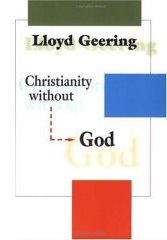
I’ve recently completed reading the book Christianity Without God, by Lloyd Geering. Geering is Emeritus Professor of Religious Studies at Victoria University, Wellington, New Zealand. I gave a review of this book followed by discussion at for my local Humanist group a few days ago.

The very notion of non-theistic Christianity may seem ludicrous to many modern conservative Christians. It probably sounds like “democracy without voting” or “football without a ball” or perhaps “chocolate milk without milk”. This is because of an interesting fact about most conservative Christians: they don’t know much about Christianity or their own Bible.

Geering’s book is a light and easy read, and is structured like one long argument; a series of premises culminating in its conclusion. For purposes of scholarship and review, I’ll point out some of the gems from its ten chapters (partially quoted and partially paraphrased), which are as follows...


• While modern science has changed our understanding of the world, we once understood it through the eyes of the Bible. The Bible was elevated in its authority as a means for the Protestants to defend their actions against the authority of the Catholic church. In their ‘Reformed Confessions on Faith’ trust in the Bible became the first article, and God is mentioned in the second. This had the little-appreciated effect of demoting God and made the Bible into an idol (see my post on Bibliolatry).

• The act of discarding outworn beliefs may not be a ‘lack of faith’ but rather the opposite. It may open the door for genuine faith to operate again. “The assertion that one needs to believe in a particular creed or set of doctrines in order to have faith is an invitation, not to faith, but to credulity.” Doubt is the enemy of false beliefs - as such doubt is not the enemy of faith but its ally.

• From Zoroastrianism and Hellenism to Judaism, Islam, and Christianity, these are all streams flowing into various branches, transforming as they go. The modern secular world, with all of its faults and problems, represents a new but legitimate stage in the Judeo-Christian cultural stream. Just as Gentile Christianity, Medieval Christendom, and Protestantism were new phases in their eras – thus, the global secular world is not the end of the Christian stream, but its next phase.

• Don Cupitt, in his 1981 book, Taking Leave of God, said that, whereas the realist traditional view of God imagines him as an objective being, the non-realist treats all God-talk as symbolic language which, though originating in ancient mythology, may still be useful in order to refer to the highest ideals, values, and aspirations to which we feel obliged to give our allegiance.

• Christians are not actually theists, but rather trinitarians. Most Christians who try to defend theism unconsciously focus on the Father Creator third and identify him alone as God.

• Tertullian, who lived from 160-200 CE, wrote the earliest reference to the trinity, although the seeds were present before then. But it wasn’t until a full two centuries after him that the trinity concept received full authorization.

• Both James and Peter viewed Jesus with Jewish eyes – as Messiah but as a full human being just as themselves. They were rejected by Jews for declaring a Messiah and given a “cold shoulder” by the Gentile Christians for not accepting Jesus as divine. We hear nothing more of them after the 5th Century.

• To fill the vacuum left by the failure of a quick second coming, early Christians engaged in a mental construction of an unseen supernatural world over the 2nd and 3rd Centuries. While the Jewish prophesy referred to a literal and physical ‘Heaven & Earth’ which had failed to arrive, it was replaced in this new supernatural scheme as a non-physical ‘Heaven & Hell’.

• One Baptist minister who Geering spoke to said, “There are three books of the Old Testament for which I have no respect at all... The book of Esther never mentions “God” at all, the Song of Songs is a collection of erotic love songs, and Ecclesiastes was written by an agnostic.”

• The humanist tradition of Hebrew Wisdom did not look to Yahweh to deliver people by miraculous interventions in either nature or human history. It taught people to pursue the way of Wisdom and it relegated God to the role of an impersonal creative force which had shaped the world to be as it was.

• Christianity’s focus shifted from its original roots – from the message to the messenger.

• Jesus stood in the Wisdom tradition more than anything else. It has led Robert Funk to say, not only that “Jesus is one of the great sages in history” but that “Jesus is also a secular sage. His parables and aphorisms all but obliterate the boundaries separating the sacred from the secular.”

• However, the Wisdom stream became completely overshadowed by the Pauline Gospel of the savior Christ, crucified, risen, and glorified.

• Protestants sought freedom from the bondage of the Catholic Church. But that freedom soon developed into another form of bondage – enslavement to the written word of the Bible. This has reached its most rigid form in modern fundamentalism.

• What is important to understand is simply this: the modern secular, humanist, post-Christian world not only flowed out of traditional Christianity but manifests the continuing development of elements intrinsic to the Judeo-Christian tradition. For this reason the modern secular and humanist world can legitimately be called ‘Christianity without God’.

• In ‘Christianity without God’ there is no place for the traditional figure of Christ as the divine Savior. Yet there is certainly a place for Jesus the teacher.

As we discussed at the gathering, Christianity (indeed many religions) has the interesting habit of changing to adapt to its time and circumstances, and often these changes would be downright heretical to previous generations of their same faith – even their same denomination. What’s most interesting is not so much the evolution of the faith, but the practice of covering their tracks. Each generation is taught “this is the way it has always been” and imagine that if they were to meet Jesus, all parties would all be on the same page. Even in cases where the evolution of their beliefs is acknowledged, the rationalization is often that previous incarnations were a distortion and the current one is in line with the true beliefs according to Jesus. But as Geering points out, nothing of the sort is true. To the contrary, the beliefs of modern mainstream conservative Christianity would be completely alien to the historical Jesus.

As a Humanist, this book left me wondering, ‘Why all the bath water?’ but this book wasn’t designed to approach pure Humanists in an attempt to convince them to become Christians. Rather, it seems to be aimed at Christians in order to show that that they need not give up their Christian cultural heritage in order to follow a more sensible, realistic, and convincing system of thought. More importantly, that system of thought is naturally derived from Christian history and recalls its roots in all the ways that matter most.

In his review of this book in The Humanist, Joseph S. Silverman, M.D. said:

“Humanistic Judaism. Humanistic Christianity. It may be quite a wait until Humanistic Islam. We should all live so long.”

America, Israel, and the Apocalypse

I usually try to stay centered on philosophy, rather than veering too much into mythology or folklore, but the effect of such on modern events cannot be denied.

Jason Boyett has recently written a nice article called "Apocalypse Soon" at Salon.com which takes a look at the United States' support of Israel, and the beliefs of Christianists concerning the Jewish people and the 'last days'. The article can be read HERE (you should make sure your pop-up blockers are on). Special thanks to Jim Kinierien for bringing it to my attention.

One of my favorite parts reads:

"There are no prophecies that have to be fulfilled before the Rapture," [Terry] James [rapture author] says. "It's imminent." In fact, the Rapture has been imminent for 2,000 years.
Which brings to mind a wonderful episode of Frontline on PBS I saw shortly before 2000 called "Apocalypse!". It was a remarkable special going into detail on the history of the concept. I thought it such a good documentary that I ordered the videotape. If you'd like to order it, you can do so by clicking HERE. Also, there is a nice website that is connected with the program HERE.

About the 'chosen people' concept, one thing I always thought peculiar: In whose holy books is it written that the Jewish people were God's chosen? Big surprise, Jewish people's. Why is it that the Aztecs, Egyptians, Greeks, or Indians didn't write that the Jews were God's chosen? Interesting and convenient.