Blog Site

Friday, January 12, 2007

A Remarkable Woman Discusses A Remarkable Man And Their Remarkable Ideas

Ann Druyan is the widow of Carl Sagan and so much more. Not only is she a gateway to learning about Sagan the man, but Druyan is a remarkable woman herself. She has produced great media productions and lectures, and contributed greatly to many causes.

I recently heard this month's episode of the webcast, Point of Inquiry, which interviewed Druyan. It was amazing to hear her eloquently explain the perspective she shared with Sagan on the universe and spirituality, as well as her defense of that approach in the light of modern issues. It seems to me that she is ahead of her time in terms of science, religion, and spirituality. Many of her thoughts are exactly what I am aiming to do with the notion of the Humanist Contemplative. Lastly, to hear her descriptions of the person who was Carl Sagan was both inspiring and amazing. Surely, it was one of the best webcasts I've heard and I highly recommend it.

Point of Inquiry: Ann Druyan - Carl Sagan and The Varieties of Scientific Experience

You can also catch Ann Druyan at the Beyond Belief '06 event on YouTube:

Beyond Belief '06 - Ann Druyan (part 1)
Beyond Belief '06 - Ann Druyan (part 2)
Beyond Belief '06 - Ann Druyan (part 3)

Either/Or's and Iraq

I had been thinking of this very thing, and intending on posting, when I saw Senator John Cornyn (R- Texas) just now on MSNBC perfectly (but unintentionally) encapsulate the error everyone seems to be making regarding the President's so-called 'plan'.

Senator Cornyn said something to the effect of (paraphrasing), 'There are two options here: we can win or we can lose, and we can't win if we don't even try. So I'm in favor of giving the President's plan a try.'

It's amazing to me that grown men who are capable enough to become Senators can make so many logical errors in a single thought - or, even worse, that they have such a low opinion of their constituency and such a loyalty to their party that they can willfully make illogical statements like this in the hopes of passing them off as genuine arguments. I have no idea which is the case here, but I suspect a little of both. I'll only spend time on one of the logical problems with Senator Cornyn's statement.

On July 22, 2005, I made a post on this blog titled "Too Many Either/Or's". This is a case where people are falling into the trap of thinking there are only two alternatives: (1) go with the President's plan, or (2) 'fail' in Iraq. Now I have the chance to take my Either/Or post from 2005 and apply it to real life...

--------------
Whenever faced with an either/or situation, or one where you feel cornered by two unattractive alternatives [in this case, sending more troops versus losing in Iraq], consider the following:

1) Question the definitions being used. It could be that the two alternatives aren't really opposed or limiting if each uses a different sense of the same words.

In this case, what do we mean by 'failure' in Iraq? Could the definition of 'failure' also include the loss of even more troops, further escalation of hostilities, and an even more disastrous outcome from troop increases and an extended conflict? In such a case, both apparent options might be a path to failure and not really be an either/or at all.

Conversely, could 'success' mean starting our exit from Iraq, thus pressuring the Iraqi government to get its act together to fill the void, and perhaps deescalate the tensions our very presence is causing? If so, then the apparent 'failure' option may not be anything of the sort.

2) Consider how the either/or's might co-exist or both be true.

As explained above, increasing troops might lead to failure just as a complete and instant withdraw might. Similarly, not increasing them (or even decreasing them) might be a part of a plan that leads to success. The increase/decrease variable and the success/fail variable are not inherently tied together as many presuppose.

3) Could the two alternatives be rooted in a shared principle or motive?

Of course, both of the options with regard to troop levels share the same motive: a stable, free Iraq and a secure America. Efforts to link those proposing one plan or another to other motives are plainly political rhetoric.

4) Think of how the either/or may be the same thing in some sense.

Many would argue that following the President's Plan is the same thing as failure in Iraq. Others would argue that not following the plan is part of a plan for success.

5) Consider whether there really are just two options - try to think of 'third options'.

If we don't increase troop levels, it doesn't mean that our only alternatives are to keep going as we are or withdraw on an artificially quick time table, allowing Iraq to fumble into whatever state it does. There are many more options.

One 'third option' might be the following:

- Increase funding, support, and personnel training and recruiting Iraqi army and police.

- Given the to-be new levels, estimate the maximum rate at which Iraq might be able to increase its levels if really desperate.

- Reduce all U.S. forces at a rate that forces Iraq to hustle to fill the void, but not so fast that they have no hope of it.

- Make exceptions to avoid the disastrous consequence of a forceful coup. This would include leaving a strike force inside the Green Zone, which could be called into action if the very existence of the elected government came into danger of being assaulted or ousted by force. It could also include a continued presence out in the countryside along the Syrian and Iranian border.

The important thing in this 'third option' would be that we get out of the business of walking urban streets, busting down doors, and so on - and yet do not risk the elected government falling by force and still continue training of Iraqi forces and monitoring the borders. There are many other 'third options' which get into details of military tactics, political maneuvering, diplomatic initiatives, unorthodox approaches, and so on.
------------------

It could very well be that a troop increase is the best option, but to believe that we are stuck between accepting the President's shift from "stay the course" to "more of the same" or accepting chaos and defeat in Iraq is nonsense. It may be helpful to those pitching the plan, but not very close to the truth of our situation. Of course, we all know that truth ranks low in matters of politics and war.

Thursday, January 11, 2007

I Am A Believer

I was thinking recently about the labels 'believer' and 'nonbeliever'. I have decided not to use them anymore for the very simple reason that the labels imply an unstated default phenomenon in which we are to believe or not believe. However...

  • I believe that the natural universe is an amazing and wondrous thing.
  • I believe that life is beautiful and valuable.
  • I believe that all human beings are worthy of compassion and concern.
  • I believe that reason, including science, is the best tool for understanding nature.
  • I believe that a virtuous life is the best path to a happy life.
  • I believe that ethics are best based on their effect on human wellbeing.

In my book, I am not a nonbeliever - I am a believer. Those other people:

  • the superstitious who disbelieve in the use of reason and evidence for claims,
  • the dogmatic who disbelieve in freethought,
  • the credulous who disbelieve in healthy skepticism,
  • the extremists who disbelieve in humility and limits to our knowledge,
  • the intolerant who disbelieve in universal compassion

- they are the nonbelievers.

Note: this post was edited on January 4, 2008 for bullet formatting.

Friday, January 5, 2007

Modern Persuits of Eudaimonia

Just as Socrates, Epictetus, and the like thought greatly about 'the good life', today the field of Positive Psychology is the study of what allows a person to have a fulfilling and happy life. It is an offshoot of the Humanistic Psychology of the 60s and 70s. It began in part as a response to the realization that psychology was always used to address illness, but never toward wellness. Positive Psychology attempts to gather hard scientific data on the consequences of our choices when it comes to behaviors.

Sounding not too dissimilar from Marcus Aurelius' list, the "Character Strengths and Virtues" manual lists six core virtues: Wisdom & Knowledge, Courage, Humanity, Justice, Temperance, and Transcendence (for the naturalists among us, that last one speaks to the appreciation of beauty and excellence, rather than transcendence to a supernatural state).

The Positive Psychology Center lists, in their FAQ, several interesting facts psychologists have determined:

  1. Wealth is only weakly related to happiness both within and across nations, particularly when income is above the poverty level (Diener & Diener, 1996).
  2. Activities that make people happy in small doses – such as shopping, good food and making money – do not lead to fulfillment in the long term, indicating that these have quickly diminishing returns (Myers, 2000; Ryan & Deci, 2000).
  3. Engaging in an experience that produces ‘flow’ is so gratifying that people are willing to do it for its own sake, rather than for what they will get out of it. The activity is its own reward. Flow is experienced when one’s skills are sufficient for a challenging activity, in the pursuit of a clear goal, with immediate feedback on progress toward the goal. In such an activity, concentration is fully engaged in the moment, self-awareness disappears, and sense of time is distorted (Csikszentmihalyi, 1990).
  4. People who express gratitude on a regular basis have better physical health, optimism, progress toward goals, well-being, and help others more (Emmons & Crumpler, 2000).
  5. Trying to maximize happiness can lead to unhappiness (Schwartz et al., 2002).
  6. People who witness others perform good deeds experience an emotion called ‘elevation’ and this motivates them to perform their own good deeds (Haidt, 2000).
  7. Optimism can protect people from mental and physical illness (Taylor et al., 2000).
  8. People who are optimistic or happy have better performance in work, school and sports, are less depressed, have fewer physical health problems, and have better relationships with other people. Further, optimism can be measured and it can be learned (Seligman, 1991; Lyubomirsky, King & Diener, 2005).
  9. People who report more positive emotions in young adulthood live longer and healthier lives (Danner, Snowdon, & Friesen, 2001).
  10. Physicians experiencing positive emotion tend to make more accurate diagnoses (Isen, 1993).
  11. Healthy human development can take place under conditions of even great adversity due to a process of resilience that is common and completely ordinary (Masten, 2001).
  12. There are benefits associated with disclosive writing. Individuals who write about traumatic events are physically healthier than control groups that do not. Individuals who write about the perceived benefits of traumatic events achieve the same physical health benefits as those who write only about the trauma (King & Miner, 2000). Individuals who write about their life goals and their best imagined future achieve similar physical health benefits to those who write only about traumatic events. Further, writing about life goals is significantly less distressing than writing about trauma, and is associated with enhanced well-being (King, 2001).
  13. People are unable to predict how long they will be happy or sad following an important event (Gilbert, Pinel, Wilson, Blumberg & Wheatley, 1998; Wilson, Meyers, & Gilbert, 2001). These researchers found that people typically overestimate how long they will be sad following a bad event, such as a romantic breakup, yet fail to learn from repeated experiences that their predictions are wrong.

Friday, December 29, 2006

Religious Leaders & Sexual Issues

Most are aware of the Ted Haggard scandal at New Life Church involving homosexual activity and drug use. In another recent news item involving a gay sex scandal, Paul Barnes has resigned from his pulpit at the Grace Chapel megachurch in Denver. In yet a third news item, back at New Life Church, another pastor, Christopher Beard, has admitted to sexual misconduct and resigned. Of course, we all know of the many allegations against Catholic priests in the news media as well. I do not mention these to 'kick a religious group when it's down', but rather to ask what in the world is going on here?

Many don't remember this, but just prior to the attacks of 9/11/01, the top news item across several networks was the alleged shark attack epidemic. As it turned out, the rate of shark attacks was unchanged. What happened was a strange phenomenon of news reporting. Apparently, whenever something is considered a 'hot topic' within the 'reporter and producer subculture', every opportunity to report on it is seized, I'm guessing so as not to let competing networks get all the credit for reporting something they didn't. Or, possibly this happens because news people get it in their heads that the subject matter is something with teeth (pun only partially intended).

In any event, the result is a public that walks away with the overall impression of something that isn't true about their world. I have written about this disservice to the public, which can happen even if no particular lies are told in a specific case. In reality, the rate of sexual misconduct for religious leaders is no higher than for the rest of the population, and in many cases quite a bit lower, including even for teachers.

But even acknowledging this, there is something especially egregious about this sort of abuse when committed by a person who is supposed to be a moral authority. Even if we realize that we needn't be disproportionately frightened of religious leaders pouncing on us in dark alleys, it becomes a fascinating question to ask, in the cases that do exist, why did they happen and (for these individuals, not the group) is there some strange psychological connection between choosing a social role of projecting morality and their own individual downfall?

Over at the Self Help Magazine website, Henry E. Adams, Ph.D., Lester W. Wright, Jr., Ph.D. and Bethany A. Lohr ask the question, is homophobia associated with homosexual arousal? There seems to be a connection and this may explain some of these cases, but it is too easy to fall into the temptation to brand all anti-homosexuals as having homosexual tendencies, simply because we know it will irk them so.

In other cases, it may be that the feelings of guilt over what they've been raised to believe is evil may cause them to try and make up for their feelings by acting in the opposite extreme. Or perhaps the reason is less personal and more abstract - meaning there is a philosophic perspective that people need rigid authoritarian ethical institutions to 'keep them in line' because they know from their first hand experience how difficult it is to self regulate. In cases involving celibate clergy, it may simply be that this lifestyle attracts people with a variety of personal or social difficulties involving sexual relations or the perceived need to hide them.

I'm sure, as with all things involving people, the reasons are varied and complex, which is what makes it an interesting and important topic if explored thoughtfully, fairly, and without exaggerating frequencies or simplistic agendas of demonizing or making fun of other groups.

Many thanks to my wife Julie, who supplied me with many of the linked references for this post.

Friday, December 22, 2006

New Parent ISO Reason & Truth

A reader named Matt recently wrote to me to ask about Stoicism and with a dilemma that I think must be fairly common in the Western world these days:

"I wanted to thank you for the brilliant website you maintain. I have found it to be tremendous and thought provoking resource as I have been researching and understanding various philosophies of life. What has recently intensified my search for a new philosophy of life has been the recent birth to my wife and I our our first child. My belief is that I have a duty to provide to our son a logical and moral system of beliefs that he can use to deal with the difficulties of modern life and use to live a happy, fulfilled and moral life.

"While not a regular church-goer, I have been nominally Christian for much of my life. However, since my middle teen years, I have been increasingly unable to reconcile so many precepts of Christian faith with logic and reason. The traditions, sense of community and fellowship, and generally sound moral guidance that are part of many churches are a wonderful thing. However, I find it difficult to reconcile myself to what I see as the inherently hypocritical position of belonging to a church when I do not in my heart believe in the most basic 'supernatural' tenants of Christian faith."

We had a nice exchange on the issue and I thought it might be useful or interesting to others. Therefore I've posted the full email exchange on my philosophy site, which can be read by clicking the link below...

Stoicism and the Search for Truth

The Supernaturalization of Scripture

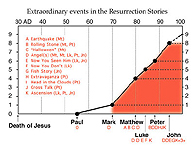
My wife, Julie, has recently alerted me to an interesting article at the Freedom From Religion Foundation website, extracted from an earlier book, Abuse Your Illusions. The article is called, "Did Jesus Really Rise From The Dead?" by Dan Barker. In the article he point out several discrepancies in detail between the gospels. More interesting is his data showing the rise of extraordinary (usually interpreted as 'supernatural') events in the scriptures as time went by. One would tend to think that if these extraordinary events actually took place, they would be the first events reported, with the mundane details being elaborated upon later, rather than the reverse.

Astoundingly, former preacher Barker reports:

"Many bible scholars and ministers--including one third of the clergy in the Church of England--reject the idea that Jesus bodily came back to life. So do 30% of born-again American Christians!"

The references to these claims can be found in the notes of the article. He also reports:

"Bible scholars conclude: 'On the basis of a close analysis of all the resurrection reports, [we] decided that the resurrection of Jesus was not perceived initially to depend on what happened to his body. The body of Jesus probably decayed as do all corpses. The resurrection of Jesus was not an event that happened on the first Easter Sunday; it was not an event that could have been captured by a video camera. . . . [We] conclude that it does not seem necessary for Christians to believe the literal veracity of any of the later appearance narratives.'"

The article can be read by clicking this link:

Did Jesus Really Rise From The Dead?

Saturday, December 16, 2006

Susan Blackmore & the Paranormal

I've recently discovered the website, work, and existence of a very interesting woman. Her name sounded familiar to me so I may have read her work before, but Susan Blackmore is a freelance writer and lecturer who apparently writes about memes and other interesting stuff. With a degree in parapsychology (as well as psychology and physiology), she used to write about and investigate paranormal claims. In the article linked to below, she explains why she's given up on investigating the paranormal. I hope to look into her other work more when I get the time.

Why I Have Given Up, by Susan Blackmore

Update, January 10, 2007: Susan Blackmore was a featured guest on the December 15, 2006 edition of the webcast "Point of Inquiry" (link HERE).

Friday, December 8, 2006

Panel: Faith & Morality

This December 2, 2006, Professor Thi Lam hosted a Philosophy of Religion Panel Discussion at San Jacinto College. It was subtitled, "Exploring the Relationship Between Faith & Morality". The panel consisted of four participants: Jim Ashmore representing Freethought, Zeeshan Ramzan representing Islam, Patricia Gehret representing Christianity, and myself (DT Strain) representing Humanism. It was attended by approximately 200 people.

The panel was asked four questions on the Divine Command Theory, morality, teaching morality to children, and the meaning of life. To read the questions and my response to them, you can click HERE for the full article on my Philosophy Site.

Update, December 14, 2006: A video of the conference is also available. Part I is HERE and part II is HERE.

Kurtz on "Atheism News"

There is a website called "Atheism News", and this November they posted a video from the Center for Inquiry, which is run by the Council for Secular Humanism. In the video, founder Paul Kurtz explains, "What is Secular Humanism?"

The video lasts about an hour and makes for a good overview of the Secular Humanist approach to those not familiar with it. To see the video, click the link below.


What is Secular Humanism?